- Library
- Food & Hospitality
- Restaurant Audit Checklist
Restaurant Audit Checklist
67 questions in 9 sectionsInteractive preview: try the answers
Section 1 of 9 · 6 questionsStaff
Is the person in charge present, performing duties, and meets food safety knowledge or certification requirements?
Is management aware of symptom and illness reporting, restriction, and exclusion rules?
Are all employees informed of symptom and illness reporting requirements?
Are all employees in the facility free of persistent coughing, sneezing, runny nose, and watery eyes, and free of symptoms and illnesses requiring reporting, exclusion, and restriction?
Are drinking and drink storage requirements being followed?
Are eating and smoking activities only occurring in appropriate designated areas?
Section 2 of 9 · 10 questionsCooking & Food Preparation
Are foods cooked to proper minimum temperatures, verified with a calibrated thermometer?
Is there no bare-hand contact with ready-to-eat foods?
Are single-use gloves being used for only one task?
Is food not being served if it is unsafe, contaminated, unprotected, or previously served unwrapped?
Have specialized food processes been approved by the TN Dept. of Health, and are established procedures being followed?
Do food workers have clean outer clothing, effective hair restraints, wear no jewelry other than a plain wedding band and wear clean gloves in good repair if wearing nail polish or artificial nails?
Are only approved thawing methods being used (refrigeration, during cooking, under running water for the proper time and at the appropriate temperature, etc.)?
Do foods packaged in the establishment meet labeling requirements (requirements may include the common name of food, list of ingredients, major food allergen information, nutrition labeling, etc.)?
If using specialized processing methods (smoking for preservation, curing, reduced oxygen packaging, sprouting seeds/beans, using food additives, etc.), has a variance been obtained from the TN Dept. of Health?
Are gloves being properly used, including hands washed before putting on gloves; gloves changed when they are damaged/dirty, tasks are changed, after handling dirty utensils/equipment, after working with raw meat; and when employees are finished using gloves, gloves are discarded, and hands are washed?
Section 3 of 9 · 4 questionsFood Purchasing/Receiving
Has the food been obtained from approved sources?
Is food received at proper temperatures, in good condition, and with intact packaging?
If shell stock is used, are shell stock tags complete and available for 90 days?
If raw fish is served, are proper parasite destruction records available?
Section 4 of 9 · 5 questionsCleaning & Sanitizing
Are all food contact surfaces of utensils and equipment cleaned and sanitized, and is in-use equipment cleaned and sanitized every 4 hours?
Is hot water at a sanitizing temperature, and are sanitizer test strips available and used?
Do chemical sanitizer solutions have the proper concentration, verified with a chemical test kit?
Are wiping cloths that are not dry being stored in a sanitizing solution when not in use, with proper sanitizing solution concentration verified by a chemical test kit?
Are ware washing facilities being used appropriately (for cleaning and sanitization of food contact surfaces), with proper sanitizing procedures (verifying proper water temperature and/or chemical sanitizer concentration)?
Section 5 of 9 · 14 questionsStorage & Ingredients
Are raw animal foods separated by minimum cooking temperatures?
Are no ready-to-eat foods at risk of contamination by raw animal foods?
Are stored foods covered, unless cooling, and not in contact with soiled equipment/utensils?
Are all refrigerated, ready-to-eat, TCS foods held longer than 24 hours date marked with a "use by" date within 7 days from the date they were prepared/opened?
Have all date-marked foods past their "use by" date been discarded?
If serving a highly susceptible population, are unpasteurized juices, raw or partially cooked animal foods, and raw seed sprouts not served?
Are only pasteurized eggs used in recipes for undercooked eggs?
Are food and color additives used properly, and are sulfites not applied to fruits/vegetables for raw consumption?
Are only pasteurized eggs used when eggs are used as an ingredient in ready-to-eat foods?
Are foods in freezing storage frozen, and does the flow of frozen food ensure foods remain frozen until taken out for cooking/preparation?
Are containers holding food or food ingredients clearly labeled with the common name of the food?
Are raw shucked shellfish labeled with name, address, cert. #, and sell by date/date shucked?
Is contamination of food being prevented during preparation, storage, and display?
Are raw fruits and vegetables washed before preparation or before being served as ready-to-eat?
Section 6 of 9 · 7 questionsHolding, Cooling, & Reheating
Before being placed in hot holding, are reheated foods heated from ≤ 41° F to ≥ 165° F for at least 15 seconds?
Are foods being cooled from ≥ 135° F to ≤ 41° F in 6 hours or less, and in the first 2 hours, do foods reach ≤ 70° F, verified by a calibrated thermometer?
Are foods in hot holding ≥ 135° F, and foods in cold holding ≤ 41° F, verified by a calibrated thermometer?
If using time instead of temperature, is food marked to indicate when food is to be discarded (≤ 4 hours after removal from temperature control or ≤ 6 hours if the initial food temperature is at or below 41° F and does not exceed 70° F during holding), and do written procedures identify the foods held using time and how the establishment will ensure they are at the proper time?
Does the equipment meet capacity needs for cooling, heating, and holding hot and cold food at proper temperatures?
Is cooling done with approved methods: shallow pans, smaller portions, adding ice as an ingredient, etc.?
If plant food is cooked for hot holding, do food(s) reach at least 135° F before being placed in hot holding?
Section 7 of 9 · 13 questionsFacility
Are handwashing sinks operational, accessible, and properly equipped with soap and hand-drying provisions?
Does the consumer advisory in customer view identify items that may be served raw, partially cooked, or undercooked?
Are toxic chemicals (cleaning agents, sanitizers, pesticides, medicines, etc.) securely contained, labeled, separated, and not above food, equipment, utensils, or linens?
Are pests not present in the facility, and have measures been taken to prevent pests in the facility?
Are food and non-food contact surfaces in good repair and properly used?
Are non-food-contact surfaces clean and free of soil accumulations?
Are toilet facilities clean, and stocked, do the doors self-close, and does the ladies' room contain a covered trash receptacle?
Is garbage properly disposed of, and are garbage areas (inside and outside) not harboring pests and insects?
Are physical facilities properly cleaned and maintained: floors, walls, ceilings, outdoor areas, etc.?
Is ventilation preventing the accumulation of condensation, grease, and buildup?
Are personal belongings properly stored to maintain a clean and sanitary facility?
Are lights at adequate intensity?
Is the current food permit posted, and is the most recent inspection report posted?
Section 8 of 9 · 4 questionsUtensils & Equipment
Are thermometers calibrated and used to monitor cooking, holding, cooling, reheating, and storage temperatures?
Are utensils in use properly stored (in the food, in a container of ≥135° F water, under running water, etc.)?
Are utensils, equipment, and linens properly dried, stored, and handled?
Are single-use articles properly stored to prevent contamination and not being cleaned and reused?
Section 9 of 9 · 4 questionsWater & Sewage
Is water and ice from an approved source?
Are hot and cold water available, water pressure adequate, and hot water sufficient to meet peak demand?
Is the plumbing system properly maintained with operational backflow devices?
Are sewage and wastewater disposal systems working properly, and are no sewage back-ups occurring?
Checklist by GoAudits. This checklist is an example: we do not guarantee compliance with the laws applicable to your territory or industry. Seek professional advice to adapt it to your workplace or jurisdiction.
Free PDF
Download the Restaurant Audit Checklist
By downloading this checklist you agree to the GoAudits privacy policy and terms of service.
NEW! Try generating a custom checklist with our free AI tool:
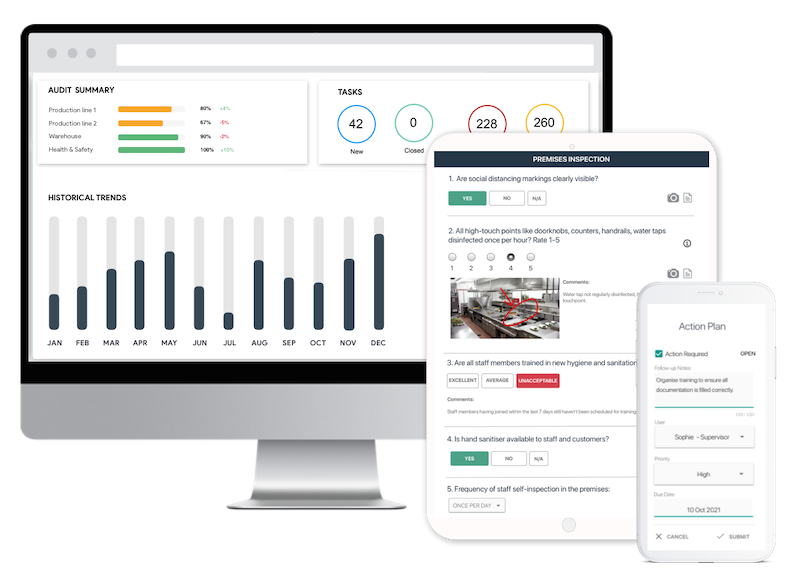
Easy inspection app for your digital checklists
- Conduct inspections anytime, anywhere - even offline
- Capture photos as proof of compliance or areas needing attention
- Instantly generate and share detailed reports after the inspections
- Assign & track follow-up tasks, view historical trends on a centralized dashboard