OSHA Sanitation Checklist
35 questions in 12 sectionsInteractive preview: try the answers
Section 1 of 12 · 6 questions1926.51(a) - Potable Water
Is an adequate supply of potable water provided in all places of employment?
Are portable containers used to dispense drinking water tightly closed and equipped with a tap?
Is there any container used to distribute drinking water clearly marked as to the nature of its contents and not used for any other purpose?
Is the common drinking cup prohibited?
Is a sanitary container for the unused single-service cups and a receptacle for disposing of the used cups provided when single-service cups are supplied?
Does "potable water" refer to water that meets the standards for drinking purposes of the State or local authority having jurisdiction, or water that meets the quality standards prescribed by the U.S. Environmental Protection Agency's National Primary Drinking Water Regulations? (40 CFR part 141)
Section 2 of 12 · 2 questions1926.51(b) - Non Potable Water
Do outlets for non-potable water, such as water for industrial or firefighting purposes, clearly indicate that the water is unsafe and is not used for drinking, washing, or cooking purposes?
Is there no cross-connection, open or potential, between a system furnishing potable and non-potable water?
Section 3 of 12 · 8 questions1926.51(c) - Toilets At Construction Jobsites
Are toilets provided for employees according to the following: 20 or less - 1
Are toilets provided for employees according to the following:20 or more - 1 toilet seat and 1 urinal per 40 workers
Are toilets provided for employees according to the following:200 or more - 1 toilet seat and 1 urinal per 50 workers
Are provisions made to ensure not less than one toilet facility is available?
Are job sites not provided with a sanitary sewer, provided with one of the following toilet facilities unless prohibited by local codes : Privies (where their use will not contaminate ground or surface water)
Are job sites not provided with a sanitary sewer, provided with one of the following toilet facilities unless prohibited by local codes : Chemical toilets?
Are job sites not provided with a sanitary sewer, provided with one of the following toilet facilities unless prohibited by local codes : Recirculating toilets.
Are job sites not provided with a sanitary sewer, provided with one of the following toilet facilities unless prohibited by local codes : Combustion toilets.
Section 4 of 12 · 3 questions1926.51(d) - Food Handling
Do all employees' food service facilities and operations meet the applicable laws, ordinances, and regulations of the jurisdictions in which they are located?
Are all employee food service facilities and operations carried out following sound hygienic principles?
In all places of employment where all or part of the food service is provided, is the food dispensed wholesome, free from spoilage, processed, prepared, handled, and stored in a manner that is protected against contamination?
Section 5 of 12 · 1 question1926.51(e) - Temporary Sleeping Quarters
Are temporary sleeping quarters heated, ventilated, and lighted when provided?
Section 6 of 12 · 2 questions1926.51(f) - Washing Facilities
Does the employer provide adequate washing facilities for employees engaged in the application of paints, coatings, herbicides, or insecticides, or in other operations where contaminants may be harmful to the employees?
Are these facilities located near the worksite and equipped to enable employees to remove such substances?
Section 7 of 12 · 1 questionGeneral
Are washing facilities maintained in a sanitary condition?
Section 8 of 12 · 4 questionsLavatories:
Are lavatories available in all places of employment?
Is each lavatory provided with hot, cold, or tepid running water?
Are hand soap or similar cleansing agents provided?
Are individual hand towels of cloth or paper, air blowers, or clean individual sections of continuous cloth toweling, convenient to the lavatories, provided?
Section 9 of 12 · 4 questionsShowers
Is one shower provided for every ten employees of each sex, who are required to shower during the same shift?
Are body soap or other appropriate cleansing agents convenient for the showers provided?
Are showers provided with hot and cold water feeding a discharge line?
Are employees who use showers provided with individual clean towels?
Section 10 of 12 · 1 question1926.51(g) - Eating And Drinking Areas
Is it ensured that no employee is allowed to consume food or beverages in a toilet room or in any area exposed to a toxic material?
Section 11 of 12 · 2 questions1926.51(h) - Vermin Control
Is every enclosed workplace constructed, equipped, and maintained, to prevent the entrance or harborage of rodents, insects, and other vermin?
Is a continuing and effective extermination program instituted where their presence is detected?
Section 12 of 12 · 1 question1926.51(i) - Change Rooms
Are change rooms equipped with storage facilities for street clothes and separate storage facilities for protective clothing provided whenever employees wear protective clothing due to the possibility of contamination with toxic materials?
Checklist by GoAudits. This checklist is an example: we do not guarantee compliance with the laws applicable to your territory or industry. Seek professional advice to adapt it to your workplace or jurisdiction.
Free PDF
Download the OSHA Sanitation Checklist
By downloading this checklist you agree to the GoAudits privacy policy and terms of service.
NEW! Try generating a custom checklist with our free AI tool:
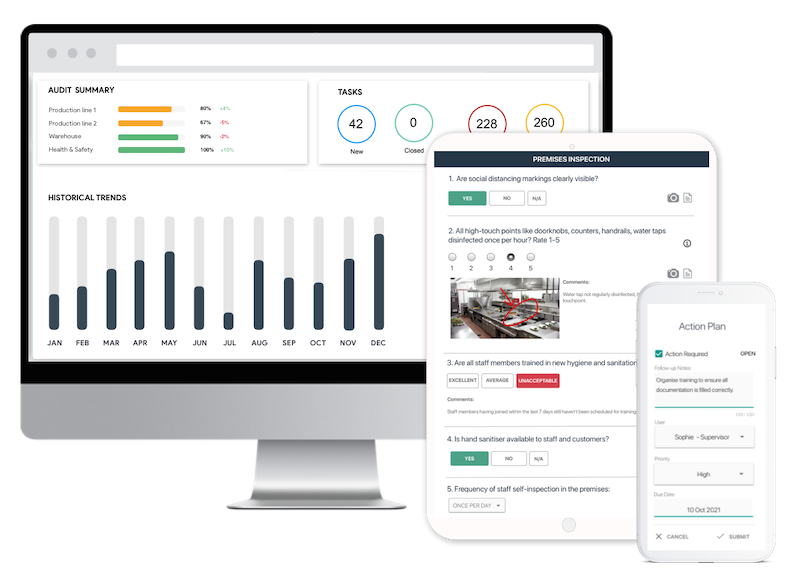
Easy inspection app for your digital checklists
- Conduct inspections anytime, anywhere - even offline
- Capture photos as proof of compliance or areas needing attention
- Instantly generate and share detailed reports after the inspections
- Assign & track follow-up tasks, view historical trends on a centralized dashboard