- Library ›
- Health & Safety ›
- OSHA Delta-P Diving Checklist
OSHA Delta-P Diving Checklist
42 questions in 7 sectionsInteractive preview: try the answers
Section 1 of 7 · 8 questionsEmergency Response Plan
Has an emergency response communication tree and process been created to inform facility personnel as well as onsite and offsite emergency personnel in the event of an incident?
Are available first aid and basic life support personnel identified for emergency operations?
Are written Go/No-Go and Emergency Termination criteria for the operation established using information identified in the dive safety plan?
Are the dive and support personnel actions listed in the event of an emergency situation, including key actions per team member role?
Is an outline provided for emergency stop procedures for operations and equipment required for water extractions if feasible?
Have actions and equipment required within the scope of the team's training been determined?
Are worst-case recovery actions and the personnel required for those actions identified?
Is the definition of rescue/recovery assets that may be needed provided?
Section 2 of 7 · 8 questionsMitigation Plan
Have plans, blueprints, photos, surveys, and/or as-built drawings been reviewed with the appropriate plant-competent people to understand the layout, geometry, and operation of the facility or structure?
Have all Delta-P hazards been located and documented with a plant representative? Have examples of these hazards, such as pumps, including ones that run intermittently such as fire pumps, flow control openings such as sluice gates, stop logs and valves, dams, locks, water tanks, cofferdams, pipeline penetrations, etc., been identified?
Has the capture zone of known hazards been calculated, and has the minimum safe distance to be maintained from those areas by the diver and the diver's umbilical been specified?
Is the work planned for when the maximum number of Delta-P sources can be eliminated, such as securing pumps and isolating valves? Note: If a plant suggests that a pump or intake cannot be secured, require a written plan for plant procedures if an umbilical or diver becomes entangled in the pump.
Has a site-specific Lockout-Tagout (LOTO) plan been developed with the facility and all concerned parties? Have items such as personal locks, physical verification, and setting of plant clearance boundaries been addressed?
Has Confined Space applicability and hazard control measures, including permit-required confined space entry protocols, been determined as required for topside personnel?
Is there a plan to install physical barriers if possible?
Has a method to verify no-flow conditions been developed, such as the use of tell-tales, flowmeters, an ROV, sonar imaging, observation of downstream water flow, etc.?
Section 3 of 7 · 4 questionsPlan The Dive
Is the scope of work planned considering Delta-P Hazards? Are alternatives to diviing and using remote sensing methods when possible (i.e., remotely operated vehicle (ROV) or sonar imaging methods) considered? Are findings being used to evaluate conditions and reduce divers' exposure to Delta-P hazards when possible?
Have all plant personnel been notified of the exact date and time ranges of diving operations?
Has the designated facility person, with sufficient technical and supervisory authority, been identified by position and name for normal and emergency contacts? Is there a facility person with direct authority onsite at all times?
Is a dive plan written based on the scope of work and Job Hazard Analysis (JHA)? Does the dive plan include a prioritized mitigation plan specific for each Delta-P hazard, an emergency action plan, and an umbilical management plan?
Section 4 of 7 · 5 questionsUmbilical Management Plan
Has the best location to tend the diver been determined to minimize exposure to entanglement and entering the capture zone?
Has the travel path of the diver and umbilical relative to physical structures been planned? Are distinct physical features of the work area identified and mapped to assist the diver in identifying their position relative to differential pressure sources?
Is the necessary length of the umbilical secured so that more than that length cannot be fed into the water? Is the umbilical physically restrained or have barriers installed to prevent it from reaching any unmitigated Delta-P capture zones?
Has a method been developed to communicate and track diver movements in real-time?
Has it been determined if sonar imaging is appropriate to monitor the diver and/or umbilical via qualified personnel?
Section 5 of 7 · 7 questionsDive Operations
Is the diver slowly deployed down a ladder or via a stage, with the diver being extremely aware of their domain? Are all water movements at the water entry point reported to the supervisor?
Do divers continuously communicate all movements using three-way communication with topside and are they tracked by monitoring umbilical length and communication with the diver and/or using sonar imaging?
Is the diver continuously tended to, with avoidance of slack in the diver's umbilical? Does the diver verbally ask for Slack (or ask for Slack to be taken up) using three-way communication?
Are measures implemented to ensure the diver is unable to reach the Delta-P hazards, such as flagging or tying the umbilical topside or installing physical barriers as applicable?
When the work site is reached, does the diver report the water flow to the supervisor and report any change immediately? If conditions are not as planned or change during the dive, is the diver brought to the surface, and the plan reevaluated?
Is the work begun only after the work area is deemed safe by the diver and diving supervisor?
Does the supervisor ensure that the dive team maintains situational awareness throughout the diving evolution?
Section 6 of 7 · 8 questionsPre-Dive
Is a pre-dive briefing conducted with the dive team, plant personnel, and any other stakeholders? Are Go/No-Go criteria for the dive operation outlined?
With plant representatives, is the mitigation plan for each Delta-P hazard verified? a. Are capture zone calculations and minimum safe distances verified with plant engineers? b. Is the work being conducted when the maximum number of Delta-P sources can be eliminated, as planned (e.g., pumps secured, valves isolated, etc.)? c. Are hazardous energy work boundary processes, such as Lockout-Tagout or clearances, executed? d. Are permit-required confined space entry protocols executed as planned for topside personnel? e. Are physical barriers prepared if applicable? f. Are no-flow conditions verified through the use of tell-tales, flowmeters, an ROV, sonar imaging, observation of downstream water flow, or other methods?
Is it possible to use sonar imaging methods to locate possible unknown DP hazards and inspect the areas prior to diving? Note: If any additional and/or new risks are identified then update the applicable sections of the dive safety plan and integrate them into the pre-dive training briefing.
Is a Just-in-Time topside dry training/mock dive conducted, including the actual work procedure, the umbilical management plan, three-way communication, emergency response actions, and each member's role?
Do all dive team members ensure domain awareness, understanding the physical form of the structure, how the plant systems work together, and where the DP hazards, including capture zones, are located?
Are communications between the dive station and plant operations and EMS tested?
Is an Emergency Response Plan briefing conducted before initiating dive operations?
Are the umbilicals secured during dive operations?
Section 7 of 7 · 2 questionsPost-Dive
Is the dive plan, work area map, and Job Hazard Analysis (JHA) modified to reflect lessons learned?
Are all plans, maps, and JHAs archived for future reference?
Checklist by GoAudits. This checklist is an example: we do not guarantee compliance with the laws applicable to your territory or industry. Seek professional advice to adapt it to your workplace or jurisdiction.
Free PDF
Download the OSHA Delta-P Diving Checklist
By downloading this checklist you agree to the GoAudits privacy policy and terms of service.
NEW! Try generating a custom checklist with our free AI tool:
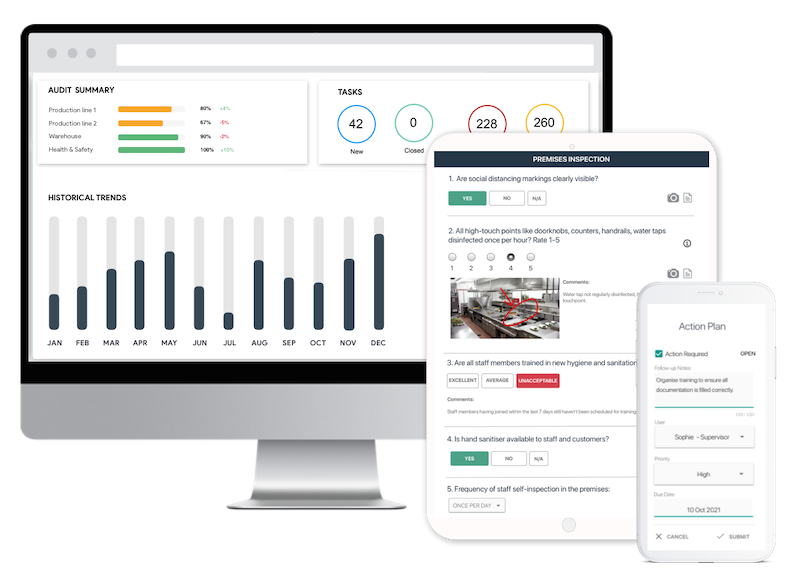
Easy inspection app for your digital checklists
- Conduct inspections anytime, anywhere - even offline
- Capture photos as proof of compliance or areas needing attention
- Instantly generate and share detailed reports after the inspections
- Assign & track follow-up tasks, view historical trends on a centralized dashboard