- Library ›
- ISO Standards ›
- ISO 45001:2018 Checklist - AS/NZ
ISO 45001:2018 Checklist - AS/NZ
137 questions in 40 sectionsInteractive preview: try the answers
Section 1 of 40 · 1 question4.1 Understanding The Organization And Its Context
4.1 Has the organization determined external and internal issues that are relevant to its purpose and does that affect its ability to achieve the intended outcome(s) of its OH&S management system?
Section 2 of 40 · 3 questions4.2 Understanding The Needs And Expectations Of Workers And Other Interested Parties
4.2a Has the organization determined the other interested parties, in addition to workers, that are relevant to the OH&S management system?
4.2b Has the organization determined the relevant needs and expectations (i.e. requirements) of workers and other interested parties?
4.2c Has the organization determined which of these needs and expectations are, or could become, legal requirements and other requirements?
Section 3 of 40 · 6 questions4.3 Determining The Scope Of The OH&S Management System
4.3.1 Has the organization determined the boundaries and applicability of the OH&S management system to establish its scope?
4.3a When determining the scope, has the organization considered the external and internal issues referred to in 4.1?
4.3b Has the organization taken into account the requirements referred to in 4.2 when determining the scope?
4.3c Has the organization taken into account the planned or performed work-related activities when determining the scope?
4.3.2 Has the organization ensured that the OH&S management system includes the activities, products, and services within its control or influence that can impact the organization’s OH&S performance?
4.3.3 Is the scope of the OH&S management system available as documented information?
Section 4 of 40 · 1 question4.4 OH&S Management System
4.4 Has the organization established, implemented, maintained, and continually improved an OH&S management system, including the processes needed and their interactions, in accordance with the requirements of this document?
Section 5 of 40 · 13 questions5.1 Leadership And Commitment
5.1a Has top management demonstrated leadership and commitment with respect to the OH&S management system by taking overall responsibility and accountability for the prevention of work-related injury and ill health, as well as the provision of safe and healthy workplaces and activities?
5.1b Has top management ensured that the OH&S policy and related OH&S objectives are established and are compatible with the strategic direction of the organization?
5.1c Has top management ensured the integration of the OH&S management system requirements into the organization’s business processes?
5.1d Has top management ensured that the resources needed to establish, implement, maintain, and improve the OH&S management system are available?
5.1e Has top management communicated the importance of effective OH&S management and of conforming to the OH&S management system requirements?
5.1f Has top management ensured that the OH&S management system achieves its intended outcome(s)?
5.1g Has top management directed and supported persons to contribute to the effectiveness of the OH&S management system?
5.1h Has top management ensured and promoted continual improvement of the OH&S management system?
5.1i Has top management supported other relevant management roles to demonstrate their leadership as it applies to their areas of responsibility?
5.1j Has top management developed, led, and promoted a culture in the organization that supports the intended outcomes of the OH&S management system?
5.1k Has top management ensured the protection of workers from reprisals when reporting incidents, hazards, risks, and opportunities?
5.1l Has top management ensured the organization establishes and implements a process(es) for consultation and participation of workers?
5.1m Has top management supported the establishment and functioning of health and safety committees?
Section 6 of 40 · 10 questions5.2 OH&S Policy
5.2a Has top management established, implemented, and maintained an OH&S policy that includes a commitment to provide safe and healthy working conditions for the prevention of work-related injury and ill health and is appropriate to the purpose, size, and context of the organization and to the specific nature of its OH&S risks and OH&S opportunities?
5.2b Has the OH&S policy provided a framework for setting the OH&S objectives?
5.2c Has the OH&S policy included a commitment to fulfill legal requirements and other requirements?
5.2d Has the OH&S policy included a commitment to eliminate hazards and reduce OH&S risks?
5.2e Has the OH&S policy included a commitment to continual improvement of the OH&S management system?
5.2f Has the OH&S policy included a commitment to consultation and participation of workers, and, where they exist, workers’ representatives?
5.2.1 Is the OH&S policy available as documented information?
5.2.2 Has the OH&S policy been communicated within the organization?
5.2.3 Is the OH&S policy available to interested parties, as appropriate?
5.2.4 Is the OH&S policy-relevant and appropriate?
Section 7 of 40 · 4 questions5.3 Organizational Roles, Responsibilities, And Authorities
5.3.1 Has top management ensured that the responsibilities and authorities for relevant roles within the OH&S management system are assigned and communicated at all levels within the organization and maintained as documented information?
5.3.2 Have workers at each level of the organization assumed responsibility for those aspects of the OH&S management system over which they have control?
5.3a Has top management assigned the responsibility and authority for ensuring that the OH&S management system conforms to the requirements of this document?
5.3b Has top management assigned the responsibility and authority for reporting on the performance of the OH&S management system to top management?
Section 8 of 40 · 6 questions5.4 Consultation And Participation Of Workers
5.4 Has the organization established, implemented, and maintained a process(es) for consultation and participation of workers at all applicable levels and functions, and, where they exist, workers’ representatives, in the development, planning, implementation, performance evaluation, and actions for improvement of the OH&S management system?
5.4a Has the organization provided mechanisms, time, training, and resources necessary for consultation and participation?
5.4b Has the organization provided timely access to clear, understandable, and relevant information about the OH&S management system?
5.4c Has the organization determined and removed obstacles or barriers to participation, or minimized those that cannot be removed?
5.4d Has the organization emphasized the consultation of non-managerial workers on the following aspects? • Determining the needs and expectations of interested parties (see 4.2); • Establishing the OH&S policy (see 5.2); • Assigning organizational roles, responsibilities, and authorities, as applicable (see 5.3); • Determining how to fulfill legal requirements and other requirements (see 6.1.3); • Establishing OH&S objectives and planning to achieve them (see 6.2); • Determining applicable controls for outsourcing, procurement, and contractors (see 8.1.4); • Determining what needs to be monitored, measured, and evaluated (see 9.1); • Planning, establishing, implementing, and maintaining an audit programme(s) (see 9.2.2); • Ensuring continual improvement (see 10.3);
5.4e Has the organization emphasized the participation of non-managerial workers in the following? • Determining the mechanisms for their consultation and participation; • Identifying hazards and assessing risks and opportunities (see 6.1.1 and 6.1.2); • Determining actions to eliminate hazards and reduce OH&S risks (see 6.1.4); • Determining competence requirements, training needs, training, and evaluating training (see 7.2); • Determining what needs to be communicated and how this will be done (see 7.4); • Determining control measures and their effective implementation and use (see 8.1, 8.1.3, and 8.2); • Investigating incidents and nonconformities and determining corrective actions (see 10.2)?
Section 9 of 40 · 6 questions6.1 Actions To Address Risks And Opportunities - 6.1.1 General
Has the organization considered the issues referred to in 4.1 (context), 4.2 (interested parties), and 4.3 (the scope of its OH&S management system) when planning for the OH&S management system?
Has the organization determined the risks and opportunities that need to be addressed to: a) give assurance that the OH&S management system can achieve its intended outcome(s)? b) prevent or reduce undesired effects? c) achieve continual improvement?
When determining the risks and opportunities for the OH&S management system, does the organization take into account: — hazards (see 6.1.2.1)? — OH&S risks and other risks (see 6.1.2.2)? — OH&S opportunities and other opportunities (see 6.1.2.3)? — legal requirements and other requirements (see 6.1.3)?
In its planning processes, does the organization determine and assess the risks and opportunities relevant to the intended outcomes of the OH&S management system associated with changes in the organization, its processes, or the OH&S management system?
In the case of planned changes, does the organization assess the risks before the change is implemented (see 8.1.3)?
Does the organization maintain documented information on: — risks and opportunities? — the process(es) and actions needed to determine and address its risks and opportunities (see 6.1.2 to 6.1.4)?
Section 10 of 40 · 3 questions6.1.2 Hazard Identification And Assessment Of Risks And Opportunities - 6.1.2.1 Hazard Identification
Has the organization established, implemented, and maintained a process(es) for hazard identification that is ongoing and proactive?
Does the process(es) take into account, but not limited to: a) how work is organized, social factors (including workload, work hours, victimization, harassment, and bullying), leadership, and culture in the organization?
Does the process(es) take into account, but not limited to: routine and non-routine activities and situations, including hazards arising from: infrastructure, equipment, materials, substances, and physical conditions of the workplace? product and service design, research, development, testing, production, assembly, construction, service delivery, maintenance, and disposal? human factors? how the work is performed? c) past relevant incidents, internal or external to the organization, including emergencies, and their causes? d) potential emergency situations? e) people, including consideration of: those with access to the workplace and their activities, including workers, contractors, visitors, and other persons? those in the vicinity of the workplace who can be affected by the activities of the organization? workers at a location not under the direct control of the organization? f) other issues, including consideration of: the design of work areas, processes, installations, machinery/equipment, operating procedures, and work organization, including their adaptation to the needs and capabilities of the workers involved? situations occurring in the vicinity of the workplace caused by work-related activities under the control of the organization? situations not controlled by the organization and occurring in the vicinity of the workplace that can cause injury and ill health to persons in the workplace? g) actual or proposed changes in organization, operations, processes, activities, and the OH&S management system (see 8.1.3)? h) changes in knowledge of, and information about, hazards?
Section 11 of 40 · 4 questions6.1.2.2 Assessment Of OH&S Risks And Other Risks To The OH&S Management System
Has the organization established, implemented, and maintained a process(es) to: a) assess OH&S risks from the identified hazards, while taking into account the effectiveness of existing controls?
Has the organization established, implemented, and maintained a process(es) to: b) determine and assess the other risks related to the establishment, implementation, operation, and maintenance of the OH&S management system?
Are the organization’s methodologies and criteria for the assessment of OH&S risks defined with respect to their scope, nature, and timing to ensure they are proactive rather than reactive and used systematically?
Does the organization maintain and retain documented information on the methodology(ies) and criteria?
Section 12 of 40 · 2 questions6.1.2.3 Assessment Of OH&S Opportunities And Other Opportunities For The OH&S Management System
Has the organization established, implemented, and maintained a process(es) to assess: a) OH&S opportunities to enhance OH&S performance, while taking into account planned changes to the organization, its policies, its processes, or its activities, including: 1 .opportunities to adapt work, work organization, and work environment to workers? 2. opportunities to eliminate hazards and reduce OH&S risks? b) other opportunities for improving the OH&S management system?
Can OH&S risks and OH&S opportunities result in other risks and other opportunities for the organization?
Section 13 of 40 · 3 questions6.1.3 Determination Of Legal Requirements And Other Requirements
Has the organization established, implemented, and maintained a process(es) to: a) determine and have access to up-to-date legal requirements and other requirements that are applicable to its hazards, OH&S risks, and OH&S management system? b) determine how these legal requirements and other requirements apply to the organization and what needs to be communicated? c) take these legal requirements and other requirements into account when establishing, implementing, maintaining, and continually improving its OH&S management system?
Does the organization maintain and retain documented information on its legal requirements and other requirements and ensure that it is updated to reflect any changes?
Can legal requirements and other requirements result in risks and opportunities for the organization?
Section 14 of 40 · 3 questions6.1.4 Planning Action
Has the organization planned: a) actions to: 1.address these risks and opportunities (see 6.1.2.2 and 6.1.2.3)? 2.address legal requirements and other requirements (see 6.1.3)? 3.prepare for and respond to emergency situations (see 8.2)? b) how to: 4. integrate and implement the actions into its OH&S management system processes or other business processes? 5. evaluate the effectiveness of these actions?
Does the organization take into account the hierarchy of controls (see 8.1.2) and outputs from the OH&S management system when planning to take action?
When planning its actions, does the organization consider best practices, technological options, and financial, operational, and business requirements?
Section 15 of 40 · 2 questions6.2 OH&S Objectives And Planning To Achieve Them - 6.2.1 OH&S Objectives
Has the organization established OH&S objectives at relevant functions and levels in order to maintain and continually improve the OH&S management system and OH&S performance (see 10.3)?
Are the OH&S objectives: a) consistent with the OH&S policy? b) measurable (if practicable) or capable of performance evaluation? c) taking into account: 1.applicable requirements? 2.the results of the assessment of risks and opportunities (see 6.1.2.2 and 6.1.2.3)? 3.the results of consultation with workers (see 5.4) and, where they exist, workers’ representatives? d) monitored? e) communicated? f) updated as appropriate?
Section 16 of 40 · 2 questions6.2 OH&S Objectives And Planning To Achieve Them - 6.2.2 Planning To Achieve OH&S Objectives
When planning how to achieve its OH&S objectives, has the organization determined: a) what will be done? b) what resources will be required? c) who will be responsible? d) when it will be completed? e) how the results will be evaluated, including indicators for monitoring? f) how the actions to achieve OH&S objectives will be integrated into the organization’s business processes?
Does the organization maintain and retain documented information on the OH&S objectives and plans to achieve them?
Section 17 of 40 · 1 question7.1 Resources
Has the organization determined and provided the resources needed for the establishment, implementation, maintenance, and continual improvement of the OH&S management system?
Section 18 of 40 · 5 questions7.2 Competence
Has the organization determined the necessary competence of workers that affect or can affect its OH&S performance?
Does the organization ensure that workers are competent (including the ability to identify hazards) based on appropriate education, training, or experience?
Where applicable, does the organization take actions to acquire and maintain the necessary competence, and evaluate the effectiveness of the actions taken?
Does the organization retain appropriate documented information as evidence of competence?
Can applicable actions include providing training to, mentoring, or reassigning currently employed persons, or hiring or contracting competent persons?
Section 19 of 40 · 1 question7.3 Awareness
Are workers made aware of: a) the OH&S policy and OH&S objectives? b) their contribution to the effectiveness of the OH&S management system, including the benefits of improved OH&S performance? c) the implications and potential consequences of not conforming to the OH&S management system requirements? d) incidents and the outcomes of investigations that are relevant to them? e) hazards, OH&S risks, and actions determined that are relevant to them? f) their ability to remove themselves from work situations that they consider present an imminent and serious danger to their life or health, as well as the arrangements for protecting them from undue consequences for doing so?
Section 20 of 40 · 6 questions7.4 Communication - 7.4.1 General
Has the organization established, implemented, and maintained the process(es) needed for internal and external communications relevant to the OH&S management system, including determining: a) what it will communicate? b) when to communicate? c) with whom to communicate: • internally among the various levels and functions of the organization? • among contractors and visitors to the workplace? • among other interested parties? d) how to communicate?
Does the organization take into account diversity aspects (e.g., gender, language, culture, literacy, disability) when considering its communication needs?
Does the organization ensure that the views of external interested parties are considered in establishing its communication process(es)?
When establishing its communication process(es), does the organization: — take into account its legal requirements and other requirements? — ensure that OH&S information to be communicated is consistent with information generated within the OH&S management system, and is reliable?
Does the organization respond to relevant communications on its OH&S management system?
Does the organization retain documented information as evidence of its communications, as appropriate?
Section 21 of 40 · 2 questions7.4 Communication - 7.4.2 Internal Communication
Does the organization internally communicate information relevant to the OH&S management system among the various levels and functions of the organization, including changes to the OH&S management system, as appropriate?
Does the organization ensure its communication process(es) enables workers to contribute to continual improvement?
Section 22 of 40 · 1 question7.4 Communication - 7.4.3 External Communication
Does the organization externally communicate information relevant to the OH&S management system, as established by the organization’s communication process(es) and taking into account its legal requirements and other requirements?
Section 23 of 40 · 2 questions7.5 Documented Information - 7.5.1 General
Does the organization’s OH&S management system include: a) documented information required by this document? b) documented information determined by the organization as necessary for the effectiveness of the OH&S management system?
Can the extent of documented information for an OH&S management system differ from one organization to another due to: — the size of the organization and its type of activities, processes, products, and services? — the need to demonstrate fulfillment of legal requirements and other requirements? — the complexity of processes and their interactions? — the competence of workers?
Section 24 of 40 · 1 question7.5 Documented Information - 7.5.2 Creating And Updating
When creating and updating documented information, does the organization ensure appropriate: a) identification and description (e.g., a title, date, author, or reference number)? b) format (e.g., language, software version, graphics) and media (e.g., paper, electronic)? c) review and approval for suitability and adequacy?
Section 25 of 40 · 5 questions7.5 Documented Information - 7.5.3 Control Of Documented Information
Does the organization control documented information required by the OH&S management system and by this document to ensure: a) it is available and suitable for use, where and when it is needed? b) it is adequately protected (e.g., from loss of confidentiality, improper use, or loss of integrity)?
For the control of documented information, does the organization address the following activities, as applicable: — distribution, access, retrieval, and use? — storage and preservation, including preservation of legibility? — control of changes (e.g., version control)? — retention and disposition?
Does the organization identify documented information of external origin determined to be necessary for the planning and operation of the OH&S management system, and control it as appropriate?
Does access imply a decision regarding the permission to view the documented information only, or the permission and authority to view and change the documented information?
Does access to relevant documented information include access by workers, and, where they exist, workers’ representatives?
Section 26 of 40 · 2 questions8.1 Operational Planning And Control - 8.1.1 General
Has the organization planned, implemented, controlled, and maintained the processes needed to meet the requirements of the OH&S management system and implement the actions determined in Clause 6 by: a) establishing criteria for the processes? b) implementing control of the processes in accordance with the criteria? c) maintaining and retaining documented information to the extent necessary to have confidence that the processes have been carried out as planned? d) adapting work to workers?
At multi-employer workplaces, has the organization coordinated the relevant parts of the OH&S management system with other organizations?
Section 27 of 40 · 2 questions8.1 Operational Planning And Control -8.1.2 Eliminating Hazards And Reducing OH&S Risks
Has the organization established, implemented, and maintained a process(es) for the elimination of hazards and reduction of OH&S risks using the following hierarchy of controls: a) eliminate the hazard? b) substitute with less hazardous processes, operations, materials, or equipment? c) use engineering controls and reorganization of work? d) use administrative controls, including training? e) use adequate personal protective equipment (PPE)?
Does the organization ensure that PPE is provided at no cost to workers where required by legal and other regulations?
Section 28 of 40 · 3 questions8.1 Operational Planning And Control -8.1.3 Management Of Change
Has the organization established a process(es) for the implementation and control of planned temporary and permanent changes that impact OH&S performance, including: a) new products, services, processes, or changes to existing ones, including workplace locations, work organization, working conditions, equipment, and workforce? b) changes to legal requirements and other requirements? c) changes in knowledge or information about hazards and OH&S risks? d) developments in knowledge and technology?
Has the organization reviewed the consequences of unintended changes, taking action to mitigate any adverse effects as necessary?
Has the organization considered that changes can result in risks and opportunities?
Checklist by GoAudits. This checklist is an example: we do not guarantee compliance with the laws applicable to your territory or industry. Seek professional advice to adapt it to your workplace or jurisdiction.
Free PDF
Download the ISO 45001:2018 Checklist - AS/NZ
By downloading this checklist you agree to the GoAudits privacy policy and terms of service.
NEW! Try generating a custom checklist with our free AI tool:
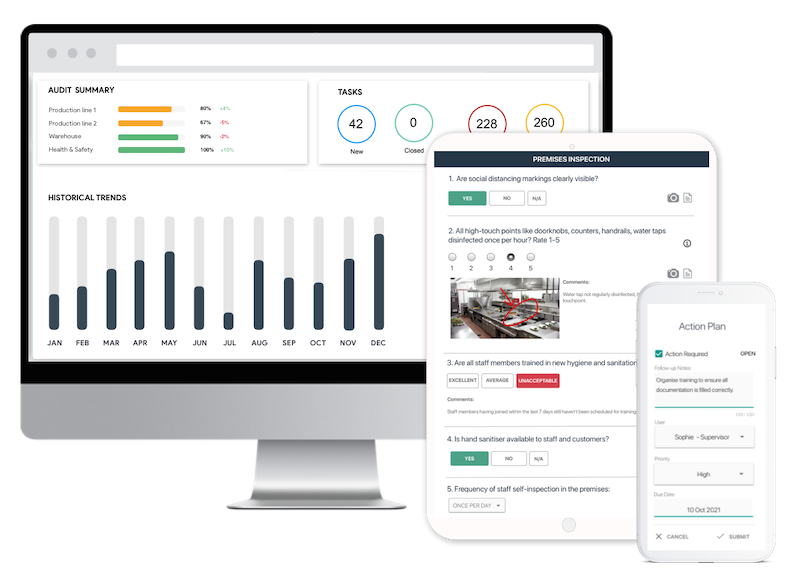
Easy inspection app for your digital checklists
- Conduct inspections anytime, anywhere - even offline
- Capture photos as proof of compliance or areas needing attention
- Instantly generate and share detailed reports after the inspections
- Assign & track follow-up tasks, view historical trends on a centralized dashboard