- Library
- Agro Tech Industry
- Globalgap Checklist Version 6 - Smart for HOPS
Globalgap Checklist Version 6 - Smart for HOPS
212 questions in 64 sectionsInteractive preview: try the answers
Section 1 of 64 · 16 questionsPrinciples & Criteria
Has the producer used subcontractors and/or service providers during the certification cycle?
Has the producer been registered for parallel ownership?
Has in-house propagation material been produced during the certification cycle (with or without treatment with any plant protection products)?
Have genetically modified organisms (GMOs) been included in the scope of the operation during the certification cycle?
Has the soil been used for cultivation purposes during the certification cycle?
Has the producer used soil fumigation during the certification cycle?
Have substrates (peat or other media) been used for cultivation purposes during the certification cycle?
Has the producer applied fertilizers (organic and/or inorganic) during the certification cycle?
Have any fertilizers (organic and/or inorganic) and/or biostimulants been stored o-site during the certification cycle?
Has the producer applied organic fertilizer on-site during the certification cycle?
Has water been stored on-site during the certification cycle?
Have crops been irrigated during the certification cycle?
Have plant protection products, biocontrol agents (biocides), and/or any other treatment products been used during the certification cycle?
Have plant protection products, biocontrol agents (biocides), and/or any other treatment products been stored on-site during the certification cycle?
Has postharvest handling taken place during the certification cycle?
Have plant protection products, biocontrol agents (biocides), and/or any other treatment products been stored and/or used on-site during the certification cycle?
Section 2 of 64 · 4 questionsHOP 01 Internal Documentation
HOP 01.01: Is a procedure in place to manage and control documents and records?
HOP 01.02: Are records for auditing purposes up-to-date and kept for a minimum period of two years, unless a longer period is required?
HOP 01.03: Does the producer complete a minimum of one self-assessment/internal audit annually to the standard?
HOP 01.04: Are effective corrective actions taken to address non-conformances detected during the self-assessments/internal audits?
Section 3 of 64 · 2 questionsHOP 02 Continuous Improvement Plan
HOP 02.01: Is a continuous improvement plan documented?
HOP 02.02: Is there evidence that a continuous improvement plan is implemented?
Section 4 of 64 · 4 questionsHOP 03 Resource Management And Training
HOP 03.01: Are the roles and responsibilities of workers whose jobs have an impact on the implementation of the standard defined?
HOP 03.02: Can individuals responsible for technical decision-making on inputs demonstrate competence?
HOP 03.03: Does worker training include the necessary skills and competencies, and is it supported by records?
HOP 03.04: Are records of all training activities kept?
Section 5 of 64 · 1 questionHOP 04 Outsourced Activities (Subcontractors)
HOP 04.01: Does the producer ensure that outsourced activities comply with the principles and criteria of the standard relevant to the services provided?
Section 6 of 64 · 2 questionsHOP 05 Specifications, Suppliers, And Stock Management
HOP 05.01: Are specifications for materials and services that are relevant to food safety available?
HOP 05.02: Is an inventory in place to manage stock on site?
Section 7 of 64 · 1 questionHOP 06 Traceability
HOP 06.01: Are all registered products traceable back to and from the registered farm where they were produced and handled (where applicable)?
Section 8 of 64 · 4 questionsHOP 07 Parallel Ownership, Traceability, And Segregation
HOP 07.01: Is an effective system in place to identify all products originating from GLOBALG.A.P. certified processes and segregate them from products originating from non-certified processes?
HOP 07.02: Is the GLOBALG.A.P. Number (GGN) indicated on all final products originating from certified production processes when registered for parallel ownership?
HOP 07.03: Is a final verification step in place to ensure the correct dispatch of products originating from certified and non-certified production processes?
HOP 07.04: Are products that are purchased from different sources identified?
Section 9 of 64 · 2 questionsHOP 08 Mass Balance
HOP 08.01: Are sales records available for all quantities sold for all registered products?
HOP 08.02: Are quantities (produced, stored, and/or purchased) recorded and summarized for all products?
Section 10 of 64 · 1 questionHOP 09 Recall And Withdrawal
HOP 09.01: Are documented procedures in place to manage the recall and withdrawal of products from the marketplace, and are such procedures tested annually?
Section 11 of 64 · 2 questionsHOP 10 Complaints
HOP 10.01: Is a complaint procedure relating to both internal and external issues covered by the standard available and implemented?
HOP 10.02: Are workers informed of their rights related to the standard, and is there a grievance mechanism available and implemented through which workers can file complaints confidentially and without fear of retaliation?
Section 12 of 64 · 1 questionHOP 11 Non-Conforming Products
HOP 11.01: Are procedures in place to manage and handle non-conforming products?
Section 13 of 64 · 1 questionHOP 12 Laboratory Testing
HOP 12.01: Does laboratory testing occur in a manner consistent with industry requirements?
Section 14 of 64 · 2 questionsHOP 13 Equipment And Devices
HOP 13.01: Are equipment, tools, and devices fit for purpose and maintained?
HOP 13.02: Is equipment stored in such a way as to prevent product contamination?
Section 15 of 64 · 1 questionHOP 14 Food Safety Policy Declaration
HOP 14.01: Has the producer completed and signed the food safety policy declaration?
Section 16 of 64 · 1 questionHOP 15 Food Defense
HOP 15.01: Is a food defense system in place to address risks associated with malicious attack or contamination?
Section 17 of 64 · 1 questionHOP 16 Food Fraud
HOP 16.01: Is a system in place to address risks associated with food fraud?
Section 18 of 64 · 1 questionHOP 17 Logo Use
HOP 17.01: Are the GLOBALG.A.P. word, trademark, QR code, or logo, as well as the GLOBALG.A.P. Number (GGN) used according to the "GLOBALG.A.P. trademarks use: Policy and guidelines"?
Section 19 of 64 · 1 questionHOP 18 GLOBALG.A.P. Status
HOP 18.01: Does transaction documentation include reference to the GLOBALG.A.P. status and the GLOBALG.A.P. Number (GGN)?
Section 20 of 64 · 8 questionsHOP 19 Hygiene
HOP 19.01: Does the farm have a documented hygiene risk assessment?
HOP 19.02: Are documented hygiene procedures in place to minimize food safety risks?
HOP 19.03: Have all persons working on the farm received hygiene training?
HOP 19.04: Are smoking, eating, chewing, and drinking confined to designated areas?
HOP 19.05: Are clean toilets provided for workers, visitors, and subcontractors in the vicinity of their work?
HOP 19.06: Are handwashing facilities available for all workers, visitors, and subcontractors who come into direct contact with products?
HOP 19.07: Is animal activity that may result in product contamination managed?
HOP 19.08: Are containers used for production and harvesting cleaned, maintained, and appropriate for use?
Section 21 of 64 · 3 questionsHOP 20.01 Risk Assessment And Training
HOP 20.01.01: Is there a documented risk assessment for workers’ health and safety?
HOP 20.01.02: Does the farm have health and safety procedures?
HOP 20.01.03: Have all staff received health and safety training according to the risk assessment?
Section 22 of 64 · 4 questionsHOP 20.02 Hazards And First Aid
HOP 20.02.01: Are accident and emergency procedures displayed and communicated?
HOP 20.02.02: Is safety advice for substances hazardous to workers’ health and safety immediately available and accessible?
HOP 20.02.03: Are first aid kits accessible at all permanent sites and fields near the work?
HOP 20.02.04: Is there always at least one person trained in first aid present on the farm whenever on-farm activities are being carried out?
Section 23 of 64 · 4 questionsHOP 20.03 Personal Protective Equipment
HOP 20.03.01: Are workers, visitors, and subcontractors equipped with suitable personal protective equipment (PPE)?
HOP 20.03.02: Is personal protective equipment (PPE) maintained in clean conditions and stored appropriately so as not to pose any contamination risk to personal items?
HOP 20.03.03: Is there evidence that the provided personal protective equipment (PPE) is used by the workers?
HOP 20.03.04: Are suitable changing facilities available where necessary?
Section 24 of 64 · 4 questionsHOP 20.04 Workers’ Welfare
HOP 20.04.01: Is there communication between management and workers on issues related to their health, safety, and welfare?
HOP 20.04.02: Do workers have access to clean drinking water, food storage, and areas to eat and rest?
HOP 20.04.03: Are on-site living quarters compliant with applicable local regulations, habitable, and equipped with basic services and facilities?
HOP 20.04.04: Is transportation provided to workers safe?
Section 25 of 64 · 5 questionsHOP 21 Site Management
HOP 21.01: Is a documented risk assessment completed for all registered sites?
HOP 21.02: Has a management plan been developed and implemented that establishes strategies for minimizing the risks identified in the risk assessment for operation suitability, and is it reviewed regularly?
HOP 21.03: Does the producer have a system for identifying sites and facilities used for production?
HOP 21.04: Is the site kept in a tidy and orderly condition?
HOP 21.05: Does the producer recognize the farm as an agricultural ecosystem that interacts with neighboring landscapes (while the legal scope of the producer is on the farm)?
Section 26 of 64 · 3 questionsHOP 22.01 Management Of Biodiversity And Habitats
HOP 22.01.01: Is biodiversity managed to enable its protection and enhancement?
HOP 22.01.02: Is biodiversity protected?
HOP 22.01.03: Is biodiversity enhanced?
Section 27 of 64 · 1 questionHOP 22.02 Ecological Upgrading Of Unproductive Sites
HOP 22.02.01: Are unproductive sites used as ecological focus areas to protect and enhance biodiversity?
Section 28 of 64 · 1 questionHOP 22.03 Natural Ecosystems And Habitats Are Not Converted Into Agricultural Areas
HOP 22.03.01: Is the management of biodiversity supported with metrics?
Section 29 of 64 · 5 questionsHOP 23 Energy Efficiency
HOP 23.01: Is on-farm energy use monitored?
HOP 23.02: Based on the results of the monitoring, is there a plan to improve energy efficiency on the farm?
HOP 23.03: Does the plan to improve energy efficiency consider minimizing the use of nonrenewable energy?
HOP 23.04: Does the drying operation perform under the best conditions regarding energy use and quality?
HOP 23.05: Is the management of energy supported with metrics?
Section 30 of 64 · 3 questionsHOP 24 Greenhouse-Gases And Climate Change
HOP 24.01: Does the farm contribute to reducing GHG emissions and removing them from the atmosphere?
HOP 24.02: Does the farm enable the formation of organic carbon in soils and in biomass?
HOP 24.03: Is the farm’s contribution to reducing and removing greenhouse gases (GHGs) from the atmosphere supported with metrics?
Section 31 of 64 · 7 questionsHOP 25 Waste Management
HOP 25.01: Is a waste management system implemented?
HOP 25.02: Are waste products and sources of pollution identified in all areas of the farm?
HOP 25.03: Are all forklifts and other driven transport trolleys clean, well maintained, and of a suitable type to avoid contamination through emissions?
HOP 25.04: Are holding areas for diesel and other fuel oil tanks environmentally safe?
HOP 25.05: Is organic waste managed in an appropriate manner to reduce the risk of contamination of the environment?
HOP 25.06: Is the water used for washing and cleaning purposes disposed of in a manner that minimizes the environmental, health, and safety impact?
HOP 25.07: Are plastics managed in a responsible way?
Section 32 of 64 · 5 questionsHOP 26 Plant Propagation Material
HOP 26.01: Is the choice of variety based on acceptable agronomic performance appropriate to the local conditions?
HOP 26.02: Are propagation materials obtained in compliance with variety registration laws, where applicable?
HOP 26.03: Are propagation materials obtained in compliance with intellectual property laws?
HOP 26.04: Are plant health quality control systems implemented and recorded for in-house propagation materials?
Checklist by GoAudits. This checklist is an example: we do not guarantee compliance with the laws applicable to your territory or industry. Seek professional advice to adapt it to your workplace or jurisdiction.
Free PDF
Download the Globalgap Checklist Version 6 - Smart for HOPS
By downloading this checklist you agree to the GoAudits privacy policy and terms of service.
NEW! Try generating a custom checklist with our free AI tool:
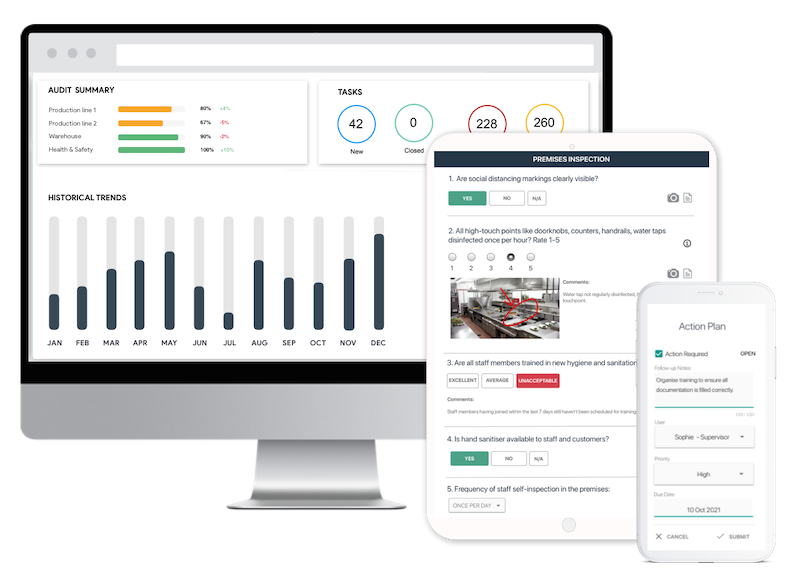
Easy inspection app for your digital checklists
- Conduct inspections anytime, anywhere - even offline
- Capture photos as proof of compliance or areas needing attention
- Instantly generate and share detailed reports after the inspections
- Assign & track follow-up tasks, view historical trends on a centralized dashboard