- Library
- Agro Tech Industry
- Globalgap Checklist Version 6 - Flowers and Ornamentals
Globalgap Checklist Version 6 - Flowers and Ornamentals
172 questions in 48 sectionsInteractive preview: try the answers
Section 1 of 48 · 14 questionsPrinciples & Criteria
Has the producer used subcontractors and/or service providers during the certification cycle?
Has the producer been registered for parallel ownership?
Has in-house propagation material been produced during the certification cycle (with or without treatment with any plant protection products)?
Have genetically modified organisms (GMOs) been included in the scope of the operation during the certification cycle?
Has the soil been used for cultivation purposes during the certification cycle?
Has the producer used soil fumigation during the certification cycle?
Have substrates (peat or other media) been used for cultivation purposes during the certification cycle?
Has the producer applied fertilizers (organic and/or inorganic) during the certification cycle?
Have any fertilizers (organic and/or inorganic) and/or biostimulants been stored on-site during the certification cycle?
Has the producer applied organic fertilizer on-site during the certification cycle?
Have crops been irrigated during the certification cycle?
Are plant protection products used between the time of harvest and prior to dispatch?
Are plant protection products and/or any other treatment products stored on-site?
Does the farm include open field areas, green areas, or room to implement living fences/hedges?
Section 2 of 48 · 3 questionsFO 01.01 Site History
FO 01.01.01: Does the producer have a system for identifying sites and facilities used for production?
FO 01.01.02: Is a recording system established for each production unit to provide a record of the production activities undertaken?
FO 01.01.03: Are records for auditing purposes up-to-date, and are they kept for a minimum period of two years, unless a longer period is required?
Section 3 of 48 · 1 questionFO 01.02 Outsourced Activities
FO 01.02.01: Does the producer ensure that outsourced activities comply with the principles and criteria of the standard relevant to the services provided?
Section 4 of 48 · 4 questionsFO 01.03 Internal Documentation
FO 01.03.01: Does the producer complete a minimum of one self-assessment/internal audit annually to the standard?
FO 01.03.02: Are effective corrective actions taken to address non-conformances detected during self-assessments/internal audits?
FO 01.03.03: Is a continuous improvement plan documented?
FO 01.03.04: Is there evidence that the continuous improvement plan is implemented?
Section 5 of 48 · 2 questionsFO 01.04 Training And Assigning Responsibilities
FO 01.04.01: Are records of all training activities kept?
FO 01.04.02: Can individuals responsible for technical decision-making on inputs demonstrate competence?
Section 6 of 48 · 1 questionFO 01.05 Customer Requirements
FO 01.05.01: Is the producer aware of and in compliance with customer quality specifications, where these exist?
Section 7 of 48 · 2 questionsFO 01.06 Complaints
FO 01.06.01: Is there a complaint procedure relating to both internal and external issues covered by the standard, and is it implemented?
FO 01.06.02: Are workers informed of their rights related to the standard, and is there a grievance mechanism available and implemented through which workers can file complaints confidentially and without fear of retaliation?
Section 8 of 48 · 1 questionFO 01.07 Non-conforming Products
FO 01.07.01: Are procedures in place to manage and handle non-conforming products?
Section 9 of 48 · 1 questionFO 01.08 Recall And Withdrawal
FO 01.08.01: Are documented procedures in place to manage the recall and withdrawal of products from the marketplace?
Section 10 of 48 · 1 questionFO 02 Traceability
FO 02.01.01: Are all registered products traceable back to and from the registered farm where they were produced and handled (where applicable)?
Section 11 of 48 · 4 questionsFO 02.02 Parallel Ownership
FO 02.02.01: Is an effective system in place to identify all products originating from GLOBALG.A.P. certified processes and segregate them from products originating from noncertified processes?
FO 02.02.02: Is the GLOBALG.A.P. Number (GGN) indicated on all final products originating from certified production processes when registered for parallel ownership?
FO 02.02.03: Is there a final verification step in place to ensure correct dispatch of products originating from certified and noncertified production processes?
FO 02.02.04: Are products that are purchased from different sources identified?
Section 12 of 48 · 3 questionsFO 02.03 Mass Balance
FO 02.03.01: Are sales records available for all quantities sold for all registered products?
FO 02.03.02: Are quantities (produced, stored, and/or purchased) recorded and summarized for all products?
FO 02.03.03: Is the product lost or discarded during handling recorded?
Section 13 of 48 · 1 questionFO 02.04 GLOBALG.A.P. Status
FO 02.04.01: Does transaction documentation include reference to the GLOBALG.A.P. status and the GLOBALG.A.P. Number (GGN)?
Section 14 of 48 · 1 questionFO 02.05 Logo Use
FO 02.05.01: Is the GLOBALG.A.P. word, trademark, QR code, logo, and the GLOBALG.A.P. Number (GGN) used according to the "GLOBALG.A.P. trademarks use: Policy and guidelines"?
Section 15 of 48 · 3 questionsFO 03.01 Propagation Material
FO 03.01.01: Are propagation materials obtained in compliance with variety registration laws, where applicable?
FO 03.01.02: Are propagation materials obtained in compliance with intellectual property laws?
FO 03.01.03: Are plant health quality control systems implemented and recorded for in-house propagation materials?
Section 16 of 48 · 2 questionsFO 03.02 Chemical Treatments And Dressings
FO 03.02.01: Is information on chemical treatments available for purchased propagation materials?
FO 03.02.02: Are up-to-date records on all chemical treatments applied to in-house propagation materials available?
Section 17 of 48 · 5 questionsFO 03.03 Genetically Modified Organisms
FO 03.03.01: Is the growing of genetically modified crops and/or trials subject to the prevailing regulations in the country of production?
FO 03.03.02: Is there documentation available if the producer grows genetically modified organisms (GMOs)?
FO 03.03.03: Have the producer's direct clients been informed of the genetically modified organism (GMO) status of the product?
FO 03.03.04: Is there a procedure available for the use and handling of genetically modified (GM) materials?
FO 03.03.05: Is adventitious mixing of genetically modified (GM) crops with conventional crops avoided?
Section 18 of 48 · 1 questionFO 03.04 Transition Period
FO 03.04.01: Does propagation material sourced from suppliers who do not have GLOBALG.A.P. certification for plant propagation material, flowers, and ornamentals, or an equivalent, need to complete a transition period?
Section 19 of 48 · 4 questionsFO 04.01 Soil Conservation
FO 04.01.01: Is crop rotation for annual crops implemented, where feasible?
FO 04.01.02: Have techniques been used to improve or maintain soil structure and avoid soil compaction?
FO 04.01.03: Does the producer use techniques to reduce the possibility of soil erosion?
FO 04.01.04: Does the producer keep records of sowing/planting dates?
Section 20 of 48 · 3 questionsFO 04.02 Soil Fumigation
FO 04.02.01: Is there documented justification for the use of soil fumigants?
FO 04.02.02: Is the pre-planting interval complied with?
FO 04.02.03: Does the producer explore alternatives to chemical fumigation before resorting to the use of chemical fumigants?
Section 21 of 48 · 4 questionsFO 04.03 Substrates
FO 04.03.01: Does the producer participate in substrate recycling?
FO 04.03.02: Are records kept of any chemicals used to sterilize substrates for reuse?
FO 04.03.03: Do substrates of natural origin come from designated conservation areas?
FO 04.03.04: Is at least 10% by volume of substrates used in production alternatives to peat, with a plan to continuously reduce the amount of peat used and to use only peat from responsible sources?
Section 22 of 48 · 1 questionFO 04.04 Nutritional Needs
FO 04.04.01: Does the application of fertilizers consider crop needs and the nutrient contribution of fertilizers, aiming to minimize nutrient loss?
Section 23 of 48 · 4 questionsFO 04.05 Nutrient Content
FO 04.05.01: Is the content of major nutrients (nitrogen, phosphorus, potassium) in applied fertilizers known?
FO 04.05.02: Are purchased inorganic fertilizers accompanied by documented evidence of chemical content, including heavy metals?
FO 04.05.03: Is a risk assessment for organic fertilizer conducted as per intended use?
FO 04.05.04: Is the use of human sewage sludge prohibited on the farm?
Section 24 of 48 · 2 questionsFO 04.06 Application Records
FO 04.06.01: Are up-to-date records of all fertilizer and biostimulant applications kept?
FO 04.06.02: Is the management of fertilizers supported with metrics?
Section 25 of 48 · 5 questionsFO 04.07 Fertilizer And Biostimulant Storage
FO 04.07.01: Are fertilizers and biostimulants stored in an appropriate manner to avoid cross-contamination?
FO 04.07.02: Are fertilizers and biostimulants stored in a covered, clean, and dry area?
FO 04.07.03: Are fertilizers and biostimulants stored in a manner that reduces the risk of environmental contamination?
FO 04.07.04: Is the purchase and use of fertilizers and/or biostimulants tracked at appropriate intervals?
FO 04.07.05: Are concentrated acids stored safely?
Section 26 of 48 · 2 questionsFO 05.01 Water Sources
FO 05.01.01: Has a risk assessment been undertaken to evaluate environmental issues for water management on the farm (pre- and postharvest)?
FO 05.01.02: Does the water management plan identify water sources and measures to address environmental issues, and increase water use efficiency?
Section 27 of 48 · 5 questionsFO 05.02 Predicting Irrigation Requirements
FO 05.02.01: Are tools routinely used to calculate and optimize crop irrigation?
FO 05.02.02: Does water use at the farm level have valid permits/licenses where legally required?
FO 05.02.03: Are restrictions indicated in water permits/licenses complied with?
FO 05.02.04: Where feasible, have measures been implemented to collect water and, where appropriate, to recycle?
FO 05.02.05: Are water storage facilities present and well maintained to take advantage of periods of maximum water availability?
Section 28 of 48 · 3 questionsFO 05.03 Record Keeping
FO 05.03.01: Are records of volumes of water abstracted from water sources kept?
FO 05.03.02: Are records kept of volumes of water used in irrigation/fertigation, including total application volumes of the previous cycle(s)?
FO 05.03.03: Are records of volumes of water used in all types of activities on the farm kept (total volume used)?
Section 29 of 48 · 3 questionsFO 05.04 Water Quality
FO 05.04.01: Is the use of treated sewage water during preharvest justified according to a risk assessment?
FO 05.04.02: Has a risk assessment on the physical and chemical quality of water used in preharvest activities been completed?
FO 05.04.03: Are corrective actions taken based on results from the risk assessment?
Section 30 of 48 · 9 questionsFO 06 Integrated Pest Management
FO 06.01: Is the implementation of integrated pest management (IPM) assisted through training or advice?
FO 06.02: Is the producer informed about the relevant pests, diseases, and weeds that affect their registered crops?
FO 06.03: Is there an integrated pest management (IPM) plan describing the measures used at the farm level to manage the relevant pests, diseases, and weeds that affect the registered crop(s)?
FO 06.04: Is the producer aware of the crop varieties’ degree of susceptibility to pests and diseases?
FO 06.05: Does the producer implement prevention measures for pest and disease control?
FO 06.06: Does the producer practice monitoring their registered crops to plan pest and disease management?
FO 06.07: Does the producer make interventions to manage pests?
FO 06.08: Have anti-resistance recommendations been followed to maintain the effectiveness of available plant protection products (PPPs)?
FO 06.09: Does the producer use the results of integrated pest management (IPM) to learn and improve the IPM plan?
Section 31 of 48 · 3 questionsFO 07.01 Choice Of Plant Protection Products
FO 07.01.01: Are only treatments with plant protection products (PPPs) authorized for the country of production used?
FO 07.01.02: Are plant protection products (PPPs) applied appropriately for the crop/use site and target – either specifically or generally – as recommended on the product label or through other approvals?
FO 07.01.03: Are invoices and/or procurement documentation of plant protection products (PPPs) and postharvest treatments kept?
Section 32 of 48 · 5 questionsFO 07.02 Application Records
FO 07.02.01: Are records of plant protection product (PPP) applications kept?
FO 07.02.02: Are additional records of all plant protection product (PPP) applications kept?
Checklist by GoAudits. This checklist is an example: we do not guarantee compliance with the laws applicable to your territory or industry. Seek professional advice to adapt it to your workplace or jurisdiction.
Free PDF
Download the Globalgap Checklist Version 6 - Flowers and Ornamentals
By downloading this checklist you agree to the GoAudits privacy policy and terms of service.
NEW! Try generating a custom checklist with our free AI tool:
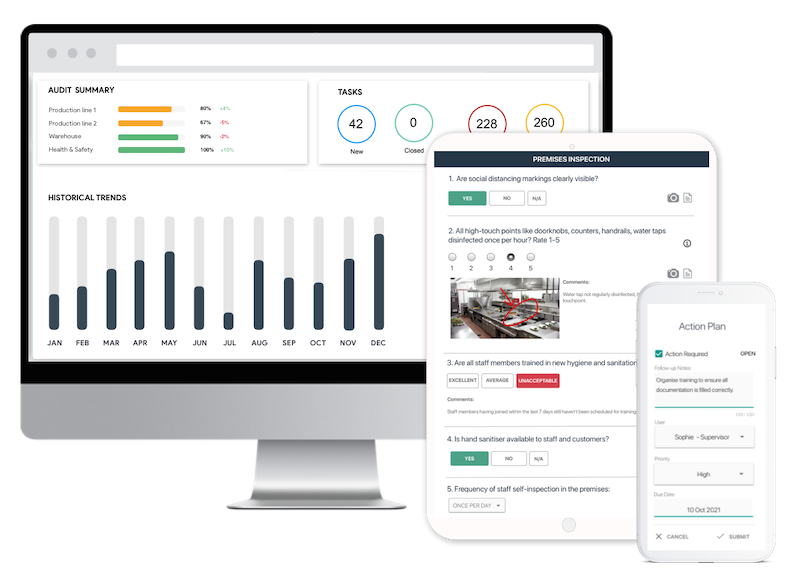
Easy inspection app for your digital checklists
- Conduct inspections anytime, anywhere - even offline
- Capture photos as proof of compliance or areas needing attention
- Instantly generate and share detailed reports after the inspections
- Assign & track follow-up tasks, view historical trends on a centralized dashboard