- Library
- Health & Safety
- Fire Protection Equipment Checklist
Fire Protection Equipment Checklist
79 questions in 12 sectionsInteractive preview: try the answers
Section 1 of 12 · 12 questionsFire Protection Equipment
Are fire extinguishers fully charged and tagged? (Is it charged if the yellow arrow in the pressure gauge is in the green area?)
Are fire extinguishers accessible?
Is the cabinet door operable; extinguisher mounted at least 4” off the floor to not more than 5 feet on top of the extinguisher?
Are fire extinguisher tags current? (serviced within the last 12 months). *(The tag expires one year from the date of inspection)
Are fire sprinklers/detectors free from obstruction?
Are sprinkler heads: storage maintained 18” below Sprinklers?
Are sprinklers in need of replacement? (damaged, corroded, painted)
When standpipe stations are enclosed in locked cabinets, and doors are equipped with approved visual identification clear glass panels, are glass panes easily broken?
Is the door capable of being opened when the glass panel is broken? Is the unlocking handle painted red?
Is the direction the handle must be pushed or pulled indicated to open the door? Is the door labeled fire equipment in case of fire, breaking glass, and operating the red handle?
Is the hose system inspected at least annually and after each use to assure that all the equipment and hoses are in place, available for use, and in serviceable condition?
Is hemp or linen hose on existing systems un-racked, physically inspected for deterioration, and re-racked using a different fold pattern at least annually?
Section 2 of 12 · 7 questionsExterior, Interior, And Environment
Are all exits, stairwells, emergency exits, and fire escapes free from stored materials that may impede evacuation?
Are emergency exit signs clear and illuminated in proper working condition?
Are emergency lights tested monthly? (push button to test)
Do automatic fire doors open properly?
Is the building free of all other fire hazards?
Is storage of any kind in corridors not permitted unless specifically permitted by regulations or in writing by the Fire Department? *(Agreements must be renewed every 5 years)
Do exit and corridor doors open, close, and latch properly? Are they propped open, or rendered inoperable unless specifically permitted in writing by the Fire Department? (Agreements must be renewed every 5 years.)
Section 3 of 12 · 13 questionsElectrical
Are extensions or phone cords not stored on the floors?
Are combustible materials not stored near an electrical switch gear or a space heater?
Are electrical outlets not exposed?
Are dried-out extension cords or "octopus" outlets not used?
Are electrical plates not missing or cracked?
Are light switches not loose or weak?
Are outlets not cracked or plugged?
Do plugs not fall out of the outlet easily?
Is the building free of all other electrical hazards?
Are outlets within 5 feet of a sink or drinking fountain equipped with a GFI? (If not, specify the location and place a work order with Physical Plant)
Is a three-foot working space maintained in front of all electrical panels?
Is there no exposed wiring?
Are portable electric space heaters in offices not allowed per the Fire Code?
Section 4 of 12 · 10 questionsHousekeeping And Storage
Are aisles in the work areas not blocked by storage items or trash?
Are storage areas kept clean and orderly, with cleaning materials safely stored?
Are combustible materials not kept in unprotected areas, such as a crawl space?
Is trash not left to accumulate in excessive quantities, and trash receptacles emptied regularly?
Are floor tiles not broken, cracked, loose, or missing?
Are carpet seams not split?
Does the carpet not have loose edges?
Are materials that could fall not stored on top of files or storage cabinets?
Are windows not broken or cracked?
Are floors not slick?
Section 5 of 12 · 7 questionsShops/Laboratories/Packing Areas
Are laboratory wastes disposed of daily with the use of appropriate precautions?
Is electrical equipment in areas near where flammable liquids are in use explosion-proof?
Do electrical appliances have warning lights and are unplugged when not in use?
Are employees aware of special hazards and trained in any special precautions necessary?
Is entry limited to authorized persons?
Are woodworking equipment dust collectors functioning adequately, and collector bins emptied regularly?
Are power tools unplugged when not in use?
Section 6 of 12 · 7 questionsHazardous Materials
Are emergency measures posted in case of accidental spills?
Are flammable/combustible liquids kept in approved safety containers?
Are flammable/combustible liquids stored in an approved cabinet?
Are safety storage cabinet vents clear of obstructions?
Are soiled rags kept in an approved self-closing waste container?
Are portable fire extinguishers in their place and of the proper type?
Are emergency measures posted in case of accidental spills?
Section 7 of 12 · 7 questionsExhibits/Collections/Book Stacks
Are exhibits and collections not overcrowded?
Do exhibit case lights show signs of overheating?
Are exhibits not blocking exit routes and/or access to fire protection equipment?
Are extension cords not used?
Are all vertical/horizontal openings in fire barriers fire-stopped?
Are salvage equipment and materials provided and accessible?
Is the fire department familiar with and has access to these areas? Are smoking regulations enforced with employees and visitors?
Section 8 of 12 · 3 questionsAuditoriums And Classrooms
Is the safe capacity posted and enforced?
Is standing and sitting in aisles prohibited?
Are smoking regulations enforced?
Section 9 of 12 · 3 questionsCommons And Eating Areas
Is the safe capacity posted and enforced?
Are aisles and exit routes unobstructed and illuminated?
Is the range, hoods, and exhaust ducts clean?
Section 10 of 12 · 3 questionsEquipment
Are desks or chairs in good working condition?
Are desks and file cabinet drawers closed to prevent tripping?
Is the building free of all other equipment hazards?
Section 11 of 12 · 4 questionsMiscellaneous
Are changes in occupancy or use reviewed by the Fire Department? (Examples include office to the laboratory, office to the meeting room, classroom to laboratory, etc.)
Are modifications to buildings, rooms, or areas reviewed by the Fire Department? Examples include removal/addition of walls, blocking of doors, adding rooms, etc.)
Do aesthetic modifications involving painting not need review by the Fire Department but may need coordination to prevent accidental activation of smoke detectors?
Are candles not allowed?
Section 12 of 12 · 3 questionsParking Lots/Grounds
Are there no tripping hazards on the sidewalks, lawn, and parking lot?
Is the parking lot adequately marked and lighted at night?
Are parking lots/grounds free of all hazards?
Checklist by GoAudits. This checklist is an example: we do not guarantee compliance with the laws applicable to your territory or industry. Seek professional advice to adapt it to your workplace or jurisdiction.
Free PDF
Download the Fire Protection Equipment Checklist
By downloading this checklist you agree to the GoAudits privacy policy and terms of service.
NEW! Try generating a custom checklist with our free AI tool:
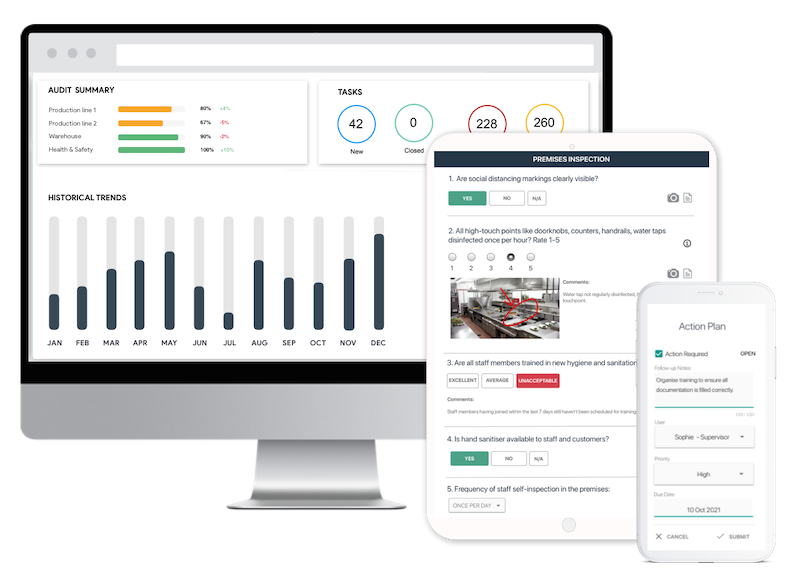
Easy inspection app for your digital checklists
- Conduct inspections anytime, anywhere - even offline
- Capture photos as proof of compliance or areas needing attention
- Instantly generate and share detailed reports after the inspections
- Assign & track follow-up tasks, view historical trends on a centralized dashboard