Contractor Safety Evaluation Checklist
183 questions in 28 sectionsInteractive preview: try the answers
Section 1 of 28 · 1 questionSite Safety Representative
Who is the site safety representative?
Section 2 of 28 · 13 questionsCal/OSHA Competent & Qualified Person(s):
What is the name of the asbestos-competent person?
What is the name of the lead competent person?
What is the name of the crane competent person?
What is the name of the confined space entry supervisor?
What is the name of the demolition competent person?
What is the name of the electrical LOTO-qualified person(s)?
What is the name of energized electrical qualified electrical worker(s)?
What is the name of the excavation & trenching competent person?
What are the names of all protection competent persons?
What are the names of all protection-qualified persons?
What is the name of the adder competent person?
What is the name of the scaffold-competent person?
What is the name of a steel erection person?
Section 3 of 28 · 6 questionsPersonal Protective Equipment
Are full-face shields available?
Are chemical splash goggles on hand?
Are welder's hood and goggles, leather gloves provided?
Are steel-toed boots accessible?
Are work gloves supplied?
Are ear plugs or ear muffs provided?
Section 4 of 28 · 2 questionsFall Protection
Is active or passive fall protection required whenever the worker is above 4 feet for maintenance or above 6 feet for construction work?
Has the subcontractor submitted the fall protection work plan and training records?
Section 5 of 28 · 9 questionsElectrical PPE
Is head protection available?
Is eye and face protection available?
Are rubber-insulating gloves provided?
Are rubber-insulating sleeves accessible?
Are leather protectors available?
Is dielectric footwear provided?
Are flame-resistant (FR)clothing provided?
Are FR face protection products available?
Is FR outerwear (Raingear, etc.) provided?
Section 6 of 28 · 5 questionsRespiratory Protection
Did the subcontractor submit the following documentation for respirator use:Respiratory Protection Plan
Did the subcontractor submit the following documentation for respirator use:Medical Surveillance Release (with personal information removed)
Did the subcontractor submit the following documentation for respirator use:Quantitative Fit Test Records
Did the subcontractor submit the following documentation for respirator use:Qualitative Fit Test Records
Did the subcontractor submit the following documentation for respirator use:Training Records
Section 7 of 28 · 4 questionsHand And Power Tools
Does the work involve the use of electrically powered tools?
Does the work involve the use of pneumatically powered tools?
Does the work performed on this project involve the use of powder-actuated tools?
Has the contractor submitted the training records for powder-actuated tools?
Section 8 of 28 · 4 questionsHand And Power Tools
Does the work scope require making penetrations into walls, ceilings, or floors deeper than 1 5/8”?
Does the work scope require excavating, trenching, digging, or otherwise penetrating the ground (including the use of stakes or poles) deeper than 1 5/8”?
Does the work scope require penetrating any concrete surface at any depth?
Are building surfaces or structures penetrated and evaluated for lead and asbestos?
Section 9 of 28 · 6 questionsHand And Power Tools
Does the work scope involve any excavation up to 5 feet deep?
Does the work scope involve any excavation deeper than 5 feet?
Does the work scope involve sanitary sewer line repair or replacement?
Does the work scope include storm sewer line repair or replacement?
Has the contractor submitted the following items for Excavation and Trenching: Job Hazard Analysis (JHA) detailing the Shoring Plan?
Has the contractor submitted the following items for Excavation and Trenching: Training Records?
Section 10 of 28 · 2 questionsHand And Power Tools
Has the contractor signed off on the Isolation Plan for electrical, gas, water, steam, or other utilities?
Has the contractor submitted an isolation plan along with a standard operating procedure (SOP) for a startup for the Demolition Plan?
Section 11 of 28 · 3 questionsHand And Power Tools
Does the work scope require traffic or pedestrian disruptions, such as blocking or partially blocking any roadway, walkway, or driveway?
Has the contractor submitted the following items:Traffic and Pedestrian Plan
Has the contractor submitted the following items:Training Records for Flaggers
Section 12 of 28 · 20 questionsHazardous Energy Control (Lockout Tag Out)
Is there any electrical work done?
Does the electrical work involve working within 42 inches of an energized electrical part (e.g., inside a VFD with an unshielded line side or within 42 inches of an energized crane bus bar)?
Is testing for zero energy conducted as part of the electrical work?
Are troubleshooting and inspection tasks performed during the electrical work?
Are changes made to the facility's electrical system (e.g., replacing breakers or wiring) as part of the electrical work?
Does the work involve working on non-electrical systems that contain hazardous energy : Mechanical
Does the work involve working on non-electrical systems that contain hazardous energy : Pneumatic
Does the work involve working on non-electrical systems that contain hazardous energy : Chemical
Does the work involve working on non-electrical systems that contain hazardous energy : Thermal
Does the work involve working on non-electrical systems that contain hazardous energy : Hydraulic
Does the work involve working on non-electrical systems that contain hazardous energy: Water
Does the work involve working on non-electrical systems that contain hazardous energy : Steam
Does the work involve working on non-electrical systems that contain hazardous energy: Gas
Does this work include service, maintenance, or modification of equipment in which the unexpected energization or start-up of the equipment, or the release of stored energy, could cause injury to people or damage to equipment?
Does work require you to overlock onto an existing LOTO lock to protect from hazardous energy?
Are you removing or opening any electrical equipment covers of electrical equipment such as boxes, panels, disconnect switches, etc?
Is any demolition work done that requires electrical equipment, walls, partitions, building structures, piping systems, ducts, etc.?
Is work done in the travel path of a crane, hoists, or other equipment that presents crush or pinch hazards?
Does your work require installing, repairing, or modifying rotating equipment?
Does your work require the potential exposure to more than 250 volts?
Section 13 of 28 · 5 questionsElevated Work Platforms
Is the Aerial Lift used?
Is the Articulating Boom Lift used?
Is Scissor Lift used?
Is the man-lift used?
Has the contractor submitted training records for each person operating the lift?
Section 14 of 28 · 13 questionsScaffolding
Are the Tubular & Coupler scaffolding used?
Is the scaffolding rolling scaffold used?
Is the mobile scaffold used?
Are Mason/Bricklayers scaffolds used?
Has the contractor submitted the following items for scaffold use: Training records for each person erecting and disassembling scaffolds
Has the contractor submitted the following items for scaffold use: A written fall protection plan (such as the LBNL fall protection matrix)
Has the contractor submitted the following items for scaffold use: Training records for users of fall protection
Has the contractor submitted the following items for scaffold use: Training records for scaffold users
Are the following ladders used on the project identified: 6’ or smaller A-Frame or Platform Ladder
Are the following ladders used on the project identified:6’ to 12’ A-Frame or Platform Ladder
Are the following ladders used on the project identified:12’ or greater A-Frame or Platform Ladder
Are the following ladders used on the project identified:Extension Ladder less than 24
Are the following ladders used on the project identified: Extension Ladder over 24’
Section 15 of 28 · 11 questionsCranes And Heavy Equipment
Is the backhoe used?
Is the front-end loader used?
Is the excavator used?
Is the crane under 3 tons used?
Is the crane over 3 tons used?
Is the forklift used?
Has the contractor submitted the following items for crane or heavy equipment: Crane's current annual inspection certification
Checklist by GoAudits. This checklist is an example: we do not guarantee compliance with the laws applicable to your territory or industry. Seek professional advice to adapt it to your workplace or jurisdiction.
Free PDF
Download the Contractor Safety Evaluation Checklist
By downloading this checklist you agree to the GoAudits privacy policy and terms of service.
NEW! Try generating a custom checklist with our free AI tool:
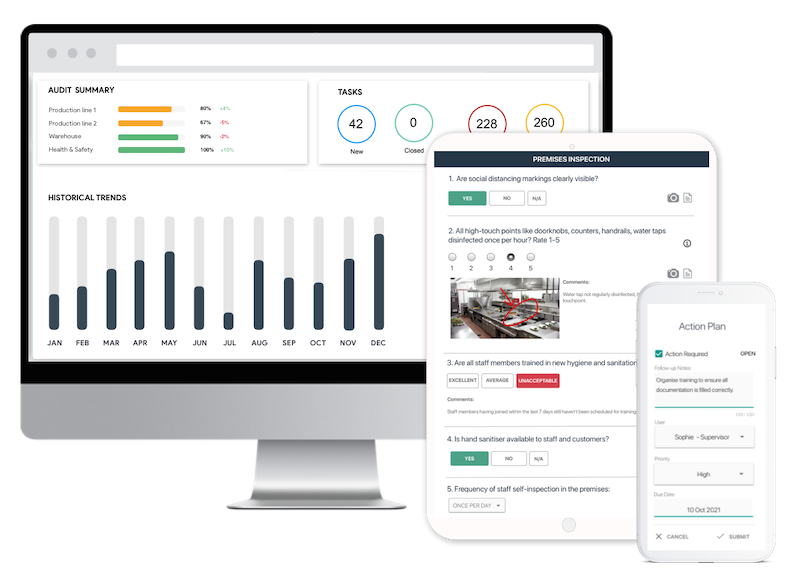
Easy inspection app for your digital checklists
- Conduct inspections anytime, anywhere - even offline
- Capture photos as proof of compliance or areas needing attention
- Instantly generate and share detailed reports after the inspections
- Assign & track follow-up tasks, view historical trends on a centralized dashboard