- Library ›
- Healthcare ›
- Aged Care Infection Control Checklist (Australia)
Aged Care Infection Control Checklist (Australia)
83 questions in 11 sectionsInteractive preview: try the answers
Section 1 of 11 · 6 questionsScreening On Entry
Does the service have the following screening procedures:Sign in the register for all visitors, agency staff, transportation staff, and other contacts who enter the service
Does the service have the following screening procedures: Pre-entry screening questions/measures/expectations of visitors clear
Does the service have the following screening procedures: Alcohol-based hand sanitizer
Does the service have the following screening procedures: Sanitiser wipes available at staff or visitor electronic sign-in
Does the service have the following screening procedures: Direction on PPE currently required to enter the service
Are signs located at all entrances to the service instructing visitors and staff not to enter if they have a fever or symptoms of a respiratory or gastrointestinal infection?
Section 2 of 11 · 23 questionsOutbreak Management Plan
What is the date last reviewed?
What is the date the plan was last practiced?
What is the name of the nominated infection prevention and control lead?
Does the plan include a list of people with allocated roles and contact details including alternative staff contacts? Is a clear staffing plan for immediate support, information, and guidance for on-site staff unfamiliar with the environment, processes, and individual consumers at all times i.e. every shift available?
Is there a current staff list with contact details, including detailed rosters and a mechanism for managing risk where staff may work across multiple aged care/disability/health care services or multiple sites?
Is there a list (spreadsheet) of all consumers including recent photos, room numbers, vaccination status, and emergency contact details?
Is there a process to identify consumers when familiar staff are not present e.g. wristbands?
Are Medicare numbers for all consumers able to be accessed when needed?
Does the plan include other key points of contact such as the PHU; Department of Health and Aged Care; GPs including after-hours GP contacts and other visiting staff; PPE stockists; surge workforce organizations; and clinical waste contractors (increase the frequency of bin collection)?
Does the service have a floor plan readily available to support isolating positive consumers and/or symptomatic consumers if required?'
Does the plan outline the following: The approach for managing all potential outbreaks including COVID-19, Acute Respiratory Illness (ARI), and gastrointestinal infections?
Does the plan outline the following: The approach for managing COVID-19 exposure?
Does the plan outline the following: The process for managing an outbreak of COVID-19, ARI, or gastroenteritis?
Does the plan outline the following: The process for identifying and defining the risk of specific exposures and the quarantine and isolation requirements?
Does the plan outline the following: How staff will be assigned to teams to support cohorts/isolating positive consumers?
Does the plan outline the following: Processes for clinical handover?
Does the plan outline the following: Guidelines to determine the decision-making process for considering when a COVID-19-positive or ARI-confirmed consumer may transfer to a hospital?
Does the plan outline the following: Details of arrangements for GP or equivalent medical access during an outbreak?
Does the plan outline the following: The service’s Communication protocol and plan? (consumers, staff, families, external bodies and professionals)
Does the plan outline the following: Access details to electronic records by all relevant parties, including a contingency plan for loss of electronic records
Are there contingency plans if practical to safely move and isolate COVID-19 or ARI-positive consumers in a single room/share with another positive consumer with an ensuite/separate bathroom or if bathrooms are shared, commodes are used to minimize sharing bathrooms?
Is there prepared signage to communicate an outbreak and to identify areas that are active with COVID-19 or ARI consumer zones/cohorts?
Is there a process to identify staff who actually worked on relevant dates (not just a roster), to determine dates, shifts, and areas of work, and the consumers they cared for?
Section 3 of 11 · 3 questionsPPE Disposal
Are there sufficient and appropriate waste bins available that are emptied frequently enough?
Are staff disposing of PPE correctly?
Is the waste service sufficient to ensure adequate waste removal from the site (large volume in outbreak)?
Section 4 of 11 · 4 questionsPPE Supply And Storage
Does the service have sufficient PPE to manage the initial phase of an outbreak until they can access their further supply (including gloves, long sleeve fluid resistant gowns, eye protection, surgical and P2/N95 masks)?
Has an area been identified for bulk stocks of PPE (pallets) to be safely delivered, received, and stored?
Are PPE stock levels monitored, stored securely, and always accessible by a designated person?
Is PPE readily available and in easy reach of staff who require it (including masks, gowns, gloves, face shields/eye protection, hand sanitizer, waste disposal bins, and liners)?
Section 5 of 11 · 10 questionsPPE Usage
Does the service have a process for overseeing and monitoring that staff are using the required PPE, and using PPE correctly?
Are there separate areas/stations for PPE donning and doffing that are clearly identified?
Are posters/instructions on donning/doffing PPE available?
Where PPE is required, are staff donning and doffing PPE correctly?
Where PPE is required, are staff correctly applying PPE?
Where required, is appropriate PPE used by staff with different roles (care/non-care staff)?
If required, is everyone (except consumers) in the service wearing the type of mask specified by the relevant State or Territory Health Department?
If required, are staff wearing face shields or other protective eyewear in addition to masks?
Are staff undertaking good hand hygiene practices and changing gloves (if applicable) between consumers?
Where PPE is required, were staff observed not to be touching their face or mask?
Section 6 of 11 · 7 questionsCommunications And Signage
Does the service have notice boards, signs, and other sources of information throughout the premises for staff, consumers, and visitors on infection prevention and control including: Hand hygiene
Does the service have notice boards, signs, and other sources of information throughout the premises for staff, consumers, and visitors on infection prevention and control including:Cough etiquette
Does the service have notice boards, signs, and other sources of information throughout the premises for staff, consumers, and visitors on infection prevention and control including:Physical distancing/staying 1.5m away from other people based on each State/Territory’s health directions (Staff/Visitors)
Does the service have notice boards, signs, and other sources of information throughout the premises for staff, consumers, and visitors on infection prevention and control including:Advice to stay at home even with the mildest of symptoms or possible exposure/close contact to COVID-19 positive person or person with other infectious disease symptoms
Does the service have notice boards, signs, and other sources of information throughout the premises for staff, consumers, and visitors on infection prevention and control including: Density signage is displayed based on each State/Territory’s health directions
Are information materials and signs language-appropriate for the consumers, staff, and visitors of the service?
Does the service have signage and processes in place to monitor staff physical distancing, e.g. during handover, breaks, entry and exit, and including remaining in separated and defined work zones based on each state/territory health directions?
Section 7 of 11 · 14 questionsConsumers
Has the service spoken to all consumers and/or consumer representatives and documented consent or the decision to refuse antiviral treatment for the consumer?
Is the information on consumer consent or the decision to refuse antivirals accessible to staff, including out-of-hours?
Is there a process to re-discuss antiviral use and consent with consumers who test COVID-19 positive and/or consumer representatives who make the decision to refuse antiviral treatment?
Has the service spoken to consumer medical officers to plan for a review of consumer health status and prescribing of antivirals for consumers who test positive for COVID-19 including out of hours?
Has the service contacted their pharmacy/pharmacies to ensure the availability of antiviral medication including out-of-hours?
Has the service provided education and training to staff on the use and administration of antivirals for consumers including where there may be swallowing difficulties?
Are consumers able to move freely outside of their rooms?
Is the service aware of the industry code for visiting aged care homes?
Are consumers and visitors observed to be participating in visits in line with the service’s policies and procedures and the principles of person-centered care (as outlined in the partnerships in care fact sheet?
Does the service have a documented risk-based approach to facilitate essential visitors to all consumers including during an outbreak?
Does the service have a documented process to ensure non-essential visitors can have contact with consumers if they become COVID-19 positive or have another viral illness?
Does the service ensure access to volunteers continues during an outbreak?
Does the service ensure access for visitors to unaffected parts of the service during an outbreak?
Does the service ensure that consumer risks are managed during an outbreak including nutrition, psychosocial, and physical activity?
Section 8 of 11 · 4 questionsEnvironment/Equipment Cleaning
Are adequate supplies in place for increased frequency of cleaning particularly high touch surfaces, including detergent for cleaning, approved disinfectant, and disinfectant wipes?
Is all shared equipment being cleaned and disinfected between consumers?
Is shared equipment such as telephones and computers, door handles, rails, chair arms, and other high-touch items being cleaned and disinfected after each use?
Are there appropriate cleaning directions and cleaning supplies for high-risk spaces including areas in isolation, staff meeting spaces, shared and separate bathrooms, kitchen, laundry, and medication administration?
Section 9 of 11 · 3 questionsHand Hygiene
Are hand washing and/or alcohol-based hand sanitizer stations readily available for staff, consumers, and visitors in all areas of the service including in the kitchen, and laundry areas?
Is there hand wash available at all hand basins and in bathrooms?
Are acceptable hand washing frequency and techniques being used by staff, consumers, and visitors?
Section 10 of 11 · 3 questionsOther Preventative Strategies
Are all staff and consumers using their own drink bottles and/or are there appropriate management plans for communal taps or fountains (as high touch points)?
Are all staff and consumers screened daily for symptoms (fever, acute respiratory symptoms, and change in behavior in consumers)?
Are visitors attending the service as per any visitor access/restriction requirements?
Section 11 of 11 · 6 questionsWorkforce
Is there a process for orientation, induction, and training in PPE and infection control, including for agency staff and/or surge workforce for each shift?
Is a process in place to ensure staff competency following PPE and infection control training that is consistent with public health directions and best practice guidance?
Is there a process in place to determine and record staff and consumer COVID vaccination and Influenza vaccination status (whether voluntarily or as required under a law of a State or Territory)? Is monitoring included when the next doses are due and is access enabled?
Is there a contingency staffing plan if a significant number of employees become sick or require quarantining (may include access details to the temporary surge workforce through the Department of Health and Aged Care)?
Do clear handover arrangements occur for consumers’ individual risks, care needs, social needs, and monitoring requirements?
Has the service determined how it can resource cleaning staff and supplies, including induction and training at surge periods?
Checklist by GoAudits. This checklist is an example: we do not guarantee compliance with the laws applicable to your territory or industry. Seek professional advice to adapt it to your workplace or jurisdiction.
Free PDF
Download the Aged Care Infection Control Checklist (Australia)
By downloading this checklist you agree to the GoAudits privacy policy and terms of service.
NEW! Try generating a custom checklist with our free AI tool:
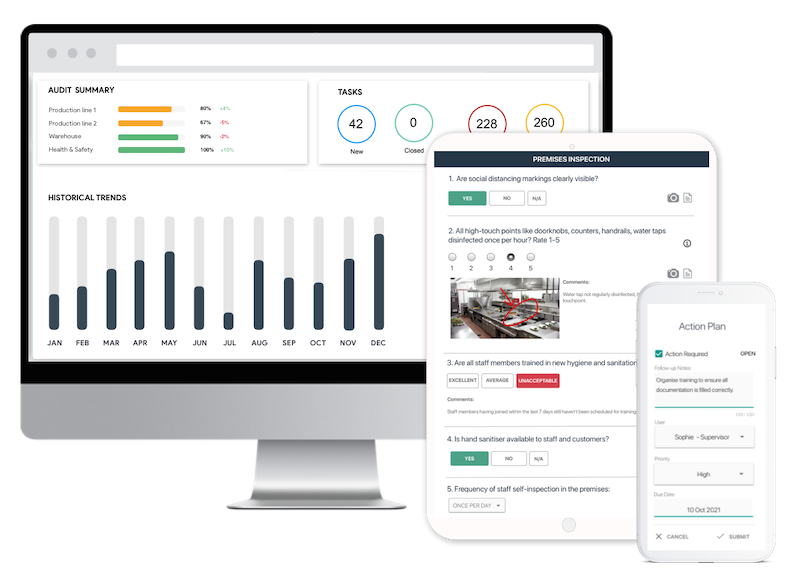
Easy inspection app for your digital checklists
- Conduct inspections anytime, anywhere - even offline
- Capture photos as proof of compliance or areas needing attention
- Instantly generate and share detailed reports after the inspections
- Assign & track follow-up tasks, view historical trends on a centralized dashboard