OSHA Checklist for General Industry
63 questions in 7 sectionsInteractive preview: try the answers
Section 1 of 7 · 6 questionsManagement Leadership
Has management implemented and communicated a written, signed policy supporting the safety and health program?
Does management routinely demonstrate a visible commitment to the program?
Has management defined specific goals and expectations for the program, along with plans for achieving the goals?
Has management allocated appropriate resources (funds and time) to accomplish goals and manage the program?
Has management assigned responsibility and accountability for implementing and maintaining the program?
Does management encourage, recognize, and reward worker contributions to workplace safety and health?
Section 2 of 7 · 9 questionsWorker Participation
Are workers encouraged to participate in the program, have the means to participate, and feel comfortable participating and giving input on safety and health issues?
Are workers trained on how to report an injury, illness, hazard, or concern, including good catches/near misses?
Do workers report injuries, illnesses, hazards, and concerns without fear of reprisal?
Are reports of injuries, illnesses, hazards, or other concerns acknowledged promptly?
Are reports of injuries, illnesses, hazards, or other concerns resolved promptly, after worker input is sought, and are they tracked to completion?
Do workers have access to the information they need to understand safety and health hazards and hazard control measures in the workplace?
Are workers assigned roles in or are otherwise involved in all aspects of the program?
Can workers participate without encountering language, skill, or education barriers, restrictions on participating during work time, or fear of retaliation or discrimination?
Do workers have the authority to initiate or request a temporary suspension or shutdown of any work activity or operation they believe to be unsafe?
Section 3 of 7 · 10 questionsHazard Identification And Assessment
Are written materials reviewed to help identify hazards, such as injury/illness logs, Safety Data Sheets, medical reports, workplace inspection results, incident investigation reports, and manufacturers’ literature?
Is the workplace inspected regularly to identify conditions that pose or could pose a safety or health concern, covering all areas and activities, including plant and transportation vehicles?
Before making changes to operations, workflow, physical plant, equipment, or materials, do workers and managers conduct a review to identify any safety or health issues?
Is the workplace evaluated to identify worker exposure to health hazards?
Are trends in injury and illness data, reports of hazards, incidents, etc., analyzed to identify common hazards?
Are incidents (including close calls/near misses) and employee complaints investigated to identify any hazards previously unrecognized or inadequately controlled, with a focus on identifying the root cause(s) of each incident?
Are hazards associated with emergencies and non-routine operations identified in the emergency action plan and operating procedures, respectively?
Are all identified hazards characterized with respect to the severity of potential outcomes, likelihood of an event or exposure, and number of workers who might be exposed, with this information identified in operating procedures?
Are interim controls adopted while permanent controls are being determined?
Are all serious and recognized hazards addressed immediately, while prioritizing remaining hazards for further control?
Section 4 of 7 · 9 questionsHazard Prevention And Control
Are options for controlling hazards identified using sources such as OSHA, NIOSH, industry best practices, and input from workers?
Are controls selected according to the “hierarchy of controls,” emphasizing elimination, substitution, engineering controls, administrative controls, and PPE?
Is a hazard control plan used to plan and prioritize controls?
Are controls installed as soon as a hazard is identified?
Are interim controls used when permanent controls cannot be immediately implemented?
Are workers involved in selecting controls?
Are controls in place to protect workers during emergencies and non-routine operations?
Once installed, are controls monitored to ensure that workers understand their use and application and to verify that they are effective?
Is the implementation of controls tracked to completion and controls inspected and maintained?
Section 5 of 7 · 11 questionsEducation And Training
Do managers, supervisors, and workers understand the elements of the safety and health program and how to participate in it?
Do workers understand the employers’ responsibilities under the program?
Does each worker understand his or her own role in the program?
Do workers know whom to contact with concerns or questions, and understand the procedures for reporting injuries, incidents, hazards, and concerns?
Do workers know they have a right to participate in the program and report injuries without fear of retaliation or discrimination?
Do workers with assigned roles under the program receive training on how to carry out their roles?
Are workers trained to understand how to recognize hazards and effective techniques for their control?
Can workers ask questions, receive answers, and provide feedback during and after training?
Do employers, managers, and supervisors understand their responsibilities under the OSH Act, procedures for responding to workers’ reports of injury, illness, or concern, techniques for identifying and controlling hazards, and fundamentals of incident investigation?
Do workers receive supplemental training when a change in the workplace could introduce new or increased hazards?
Do workers receive training in a language and at a literacy level that all of them can understand?
Section 6 of 7 · 7 questionsProgram Evaluation And Improvement
Do performance indicators track progress toward program goals?
Is performance tracked using both lagging and leading indicators?
Is performance data analyzed and shared with workers?
Does management do an initial review (and subsequent annual reviews) to evaluate the program and ensure that it is fully implemented and functioning as planned?
Are workers involved in all program review activities?
Do program reviews examine key processes to ensure that they are operating as intended?
Is the program modified as needed to correct shortcomings?
Section 7 of 7 · 11 questionsCommunication And Coordination For Host Employers, Contractors, And Staffing Agencies
Before contractors or staffing agencies bring their workers onsite, do they and the host employers determine which among them will implement the various elements of the safety and health program?
Before contractors or staffing agencies bring their workers onsite, do host employers give them enough information to assess hazards that those workers may encounter, to understand the measures taken to control them (e.g., safety and health rules, when PPE is required, whom to contact in an emergency, etc.), and to avoid creating hazards that affect workers on the site?
Do contractors and staffing agencies inform the host employer about injuries, illnesses, hazards, or concerns reported by their employees, and the results of any tracking or trend analysis that they perform?
Do contractors and staffing agencies inform the host employer of any hazards arising from their work on-site and the controls in place to address those hazards?
Before contractors or staffing agencies bring their workers onsite, do host employers give them the opportunity to conduct site visits or inspections and to review injury and illness records and other safety and health information?
Do host employers communicate with contractors, staffing agencies, and their workers about non-routine and emergency hazards and emergency procedures?
Do host employers include any safety-related specifications or qualifications in bid documents and contracts?
Do host employers coordinate with contractors and staffing agencies to ensure that work is planned and scheduled to minimize impacts on safety?
Are staffing agency workers adequately trained and equipped before arriving onsite?
Are host employer, contractor, and staffing agency policies and procedures aligned to ensure that all workers receive consistent safety information?
Do workers have access to managers with decision-making authority to resolve any coordination issues or discrepancies?
Checklist by GoAudits. This checklist is an example: we do not guarantee compliance with the laws applicable to your territory or industry. Seek professional advice to adapt it to your workplace or jurisdiction.
Free PDF
Download the OSHA Checklist for General Industry
By downloading this checklist you agree to the GoAudits privacy policy and terms of service.
NEW! Try generating a custom checklist with our free AI tool:
Easy inspection app for your digital checklists
- Conduct inspections anytime, anywhere - even offline
- Capture photos as proof of compliance or areas needing attention
- Instantly generate and share detailed reports after the inspections
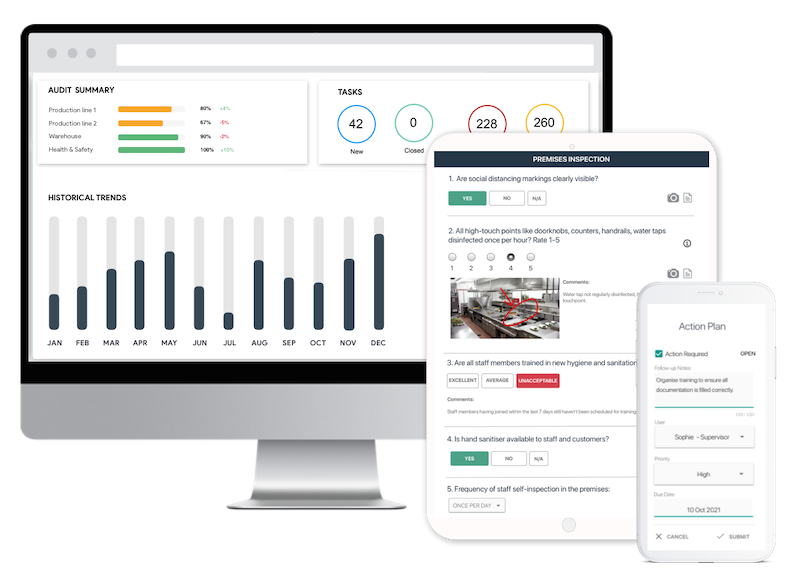
- Assign & track follow-up tasks, view historical trends on a centralized dashboard